Quick Answer — StandUpMitra Portal
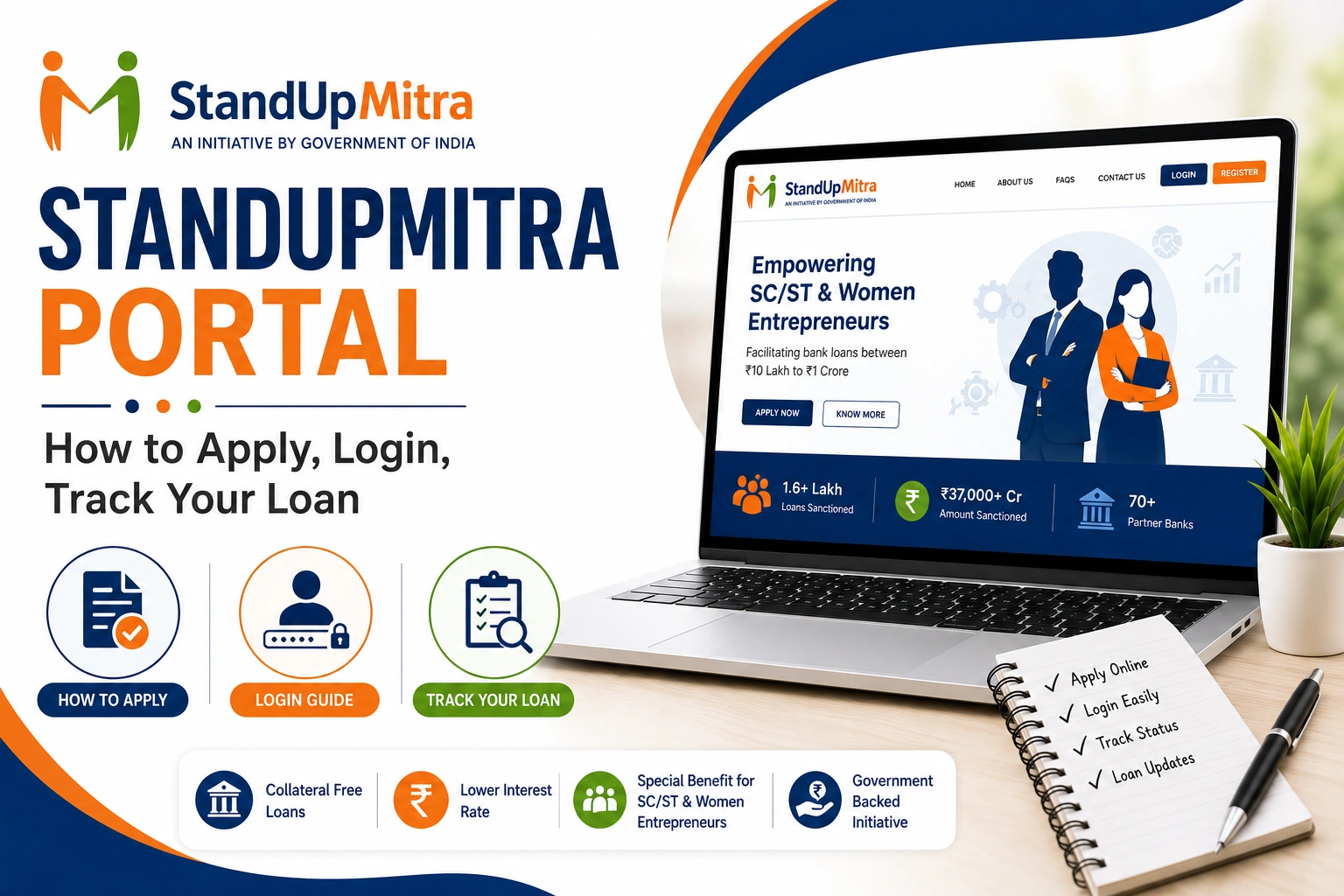
standupmitra.in is the official government portal for Stand Up India scheme applications, operated by SIDBI. SC/ST and women entrepreneurs apply here for composite loans of Rs.10 lakh to Rs.1 crore for new (greenfield) businesses. Once you submit on the portal, an application number is generated and your case is electronically assigned to a bank branch — the bank cannot ignore or “park” it. Interest rate is capped at MCLR + 3%, repayment is 7 years with 18-month moratorium, and CGTMSE guarantee coverage applies automatically.
Source: standupmitra.in
Key Takeaways
✅ standupmitra.in is the only official portal for Stand Up India — applications here are electronically tracked and cannot be quietly shelved by bank officers
✅ Loan amount: Rs.10 lakh to Rs.1 crore — composite (term loan + working capital) — for SC/ST and women entrepreneurs starting a new business
✅ Every scheduled commercial bank branch must maintain at least one SC/ST borrower and at least one women borrower under Stand Up India at all times — the quota is not optional for banks
✅ Interest rate is legally capped: bank’s MCLR + 3% maximum — a Rs.12 lakh loan at 12% comes to approximately Rs.11,400/month EMI after 18-month moratorium
✅ CGTMSE guarantee coverage applies to eligible loans under Stand Up India — no collateral requirement for most applicants
Table of Contents
Kamla Devi Ki Kahani — Lucknow, Uttar Pradesh
Kamla Devi had spent eleven years mastering chikankari embroidery. Her hands could produce work that sold in Delhi markets for Rs.800 a piece — yet she was still doing it as piece work for a middleman in Aminabad, taking home Rs.180 per item. In 2024, she had a plan. A small unit in Alambagh — four embroidery workers, two stitching machines, direct online sales, school uniform contracts. Total project cost: Rs.12 lakh.
She walked into the SBI branch nearest to her rented home, sat across from the loans officer, and explained everything. The officer looked through her documents — Aadhaar, caste certificate (SC category), no existing bank loan, no collateral — and nodded slowly. “Stand Up India scheme hai,” he said. “But this quarter ka allocation full ho gaya. Next financial year try karo.”
Kamla Devi left. She waited four months. She went back. A different officer told her the same thing — quota full. She asked for it in writing. No written rejection came.
A friend who ran a small printing press told her: “Portal pe daalo. standupmitra.in. Bank ke paas jaane ki zaroorat nahi pehle.” That same evening, from her nephew’s smartphone, Kamla Devi went to standupmitra.in. She answered 8 questions. She registered as a Ready Borrower — she already had her project plan ready. She uploaded her documents. She selected Bank of Baroda, Lucknow — not SBI.
The portal generated an application number. The system automatically sent her case to Bank of Baroda Lucknow branch and to the Lead District Manager of Lucknow. Thirty-four working days later, her Rs.12 lakh loan was sanctioned. Eighteen-month moratorium. No collateral. CGTMSE coverage applied automatically.
Her unit opened in February 2025 — five workers, direct B2B supply to two school uniform companies in Lucknow. Monthly revenue by month 6: Rs.1.85 lakh.
The bank’s “quota full” statement was never true — or it was irrelevant. The portal bypassed it entirely.
StandUpMitra Portal Kya Hai — What Exactly Is This Portal?
standupmitra.in is the official digital interface for India’s Stand Up India scheme, developed and operated by SIDBI (Small Industries Development Bank of India). It is not just an information website — it is an active application and tracking system.
Here is what the portal actually does that most applicants do not know:
1. Application routing — When you submit your application on the portal, the system electronically routes it to your chosen bank branch AND simultaneously notifies the Lead District Manager (LDM) of your district AND the nearest SIDBI/NABARD Stand-Up Connect Centre (SUCC). Three parties receive your application — not just the bank.
2. Application number generation — The moment you submit as a Ready Borrower, an application number is generated and recorded. This number is your leverage. The bank knows the application exists in the system. The LDM knows. The SUCC knows.
3. Handholding classification — The portal classifies every applicant as either a Ready Borrower (project report ready, just need the bank) or a Trainee Borrower (needs support with project report, training, registration). Each gets a different pathway.
4. Tracking dashboard — After submission, you can log back in and check application status. If a bank is stalling, the SUCC and LDM can also monitor and follow up with that bank.
5. Escalation channel — If your bank is not processing, the portal connects you to the LDM and SUCC who can formally escalate with the bank’s circle office.
This is why Kamla Devi’s portal application got processed in 34 working days after two direct bank visits produced nothing.
Who Can Apply on StandUpMitra Portal — Eligibility
| Eligibility Criteria | Details |
|---|---|
| Category | SC (Scheduled Caste) or ST (Scheduled Tribe) or Women (any caste) |
| Age | Minimum 18 years |
| Enterprise type | Greenfield only — first-time business. No expansion of existing business |
| Sector allowed | Manufacturing, Services, Trading |
| Ownership (non-individual entities) | Minimum 51% stake held by SC/ST or woman entrepreneur |
| Prior default | No wilful default on any bank/NBFC loan |
| Purpose | Setting up new enterprise — not working capital for existing business |
What “greenfield” actually means: You are starting this business from scratch. You are not expanding a shop you already run. You are not adding a second branch. This has to be your first enterprise in this line of business.
What if a woman is married to someone who runs a business? The woman herself must not have run that business. The restriction is on the applicant’s own prior enterprise history — not the spouse’s.
What if you are a general category woman? Fully eligible. The women’s category under Stand Up India is open to women of all castes and communities including general category.
StandUpMitra Portal Par Login Aur Registration — Step by Step
Step 1 — Go to standupmitra.in
Open standupmitra.in on any device. The portal is available in Hindi and English. On the homepage, click “Register” in the top navigation.
Step 2 — Answer the 8 Initial Questions
The portal asks you 8-10 short questions before registration. These are not a test — they are a routing system. Answer honestly.
| Question | What They Are Checking |
|---|---|
| Location — State and District | Routes your case to the correct LDM and SUCC office |
| Category — SC/ST/Woman | Determines which bank branch quota your application falls under |
| Nature of business planned | Manufacturing / Services / Trading — affects documentation |
| Do you have premises? | Rented or owned — you must have an address for the unit |
| Do you have a project report? | Ready Borrower vs Trainee Borrower classification |
| Do you need skill training? | If yes, linked to MSME-DI or RSETI |
| Do you have Udyam registration? | Not mandatory at application stage but affects CGTMSE processing |
| Own contribution available? | 10-25% of project cost required |
Step 3 — Ready Borrower or Trainee Borrower
Based on your answers, the portal classifies you:
Ready Borrower — You have your project report, business plan, premises identified, and own contribution arranged. The portal takes you directly to loan application. Application number is generated immediately.
Trainee Borrower — You need help with one or more of: project report, business plan, skill training, Udyam registration, margin money. The portal routes you to the LDM of your district and the nearest SUCC (SIDBI or NABARD office). They provide free support. Once your preparation is complete, your loan application is generated from the portal.
Which one should you choose? If you already have a project report — even a basic one — choose Ready Borrower. You can always ask for support after application. If you have no business plan and no idea of project cost, choose Trainee Borrower and use the free handholding.
Step 4 — Fill the Loan Application
After classification, Ready Borrowers fill the main application:
- Personal details — name, Aadhaar, PAN, address
- Business details — name, address of unit, type of activity, sector
- Loan amount required — must be between Rs.10 lakh and Rs.1 crore
- Project cost breakdown — land/building, plant/machinery, working capital
- Own contribution — how much you are putting in yourself
Step 5 — Upload Documents
Documents required at portal stage:
| Document | Format |
|---|---|
| Aadhaar Card | PDF or JPG |
| PAN Card | PDF or JPG |
| Caste Certificate (SC/ST) | PDF — issued by competent authority |
| Residence Proof | Utility bill / Voter ID / Aadhaar |
| Project Report / DPR | |
| Photographs | JPG |
| Bank account details | Cancelled cheque or passbook first page |
Note: Each bank may ask for additional documents after the portal submission. The portal upload is the primary set — the branch may call you for originals.
Step 6 — Select Bank Branch (Up to 3 Options)
The portal allows you to select up to 3 bank branches in order of preference. When you submit, your application goes to your first-choice bank. If that bank does not act within the designated timeframe, the LDM can redirect to the second or third choice.
Which bank to choose? In general: PSU banks (SBI, Bank of Baroda, Canara Bank, PNB, Union Bank) are the primary lenders under Stand Up India. Select a branch that is geographically close to your proposed business location — the bank officer will need to visit for verification.
Step 7 — Application Number Generation
After submission, you receive an application number. This is critical — save it. With this number:
- The chosen bank is notified electronically
- The Lead District Manager of your district is notified
- The nearest SUCC (SIDBI/NABARD) is notified
- You can track status on the portal dashboard
StandUpMitra Portal Par Track Kaise Karein
This is what most applicants completely miss. After submission, the portal dashboard shows:
| Status Stage | What It Means |
|---|---|
| Application Submitted | Portal has your application, bank has been notified |
| Bank Assigned | Bank branch has acknowledged receipt |
| Under Scrutiny | Bank officer is reviewing your application |
| Site Visit Scheduled | Bank officer will visit your proposed business location |
| Documents Requested | Bank needs additional papers — check your contact number |
| Sanctioned | Loan is approved — you will receive sanction letter |
| Disbursement in Progress | First tranche is being released |
If your status has been “Bank Assigned” or “Under Scrutiny” for more than 25-30 working days with no contact from the bank, do this:
- Go to portal → Contact → Find your district LDM contact
- Call or visit the LDM office — show your application number
- LDM has authority to formally follow up with the bank’s circle office
- Alternatively, contact the nearest SUCC — SIDBI or NABARD regional office
You are not bothering anyone. This is the system’s intended function. The LDM exists specifically to prevent applications from being silently ignored.
Loan Amount, Interest Rate, Repayment — Complete Table
| Parameter | Details |
|---|---|
| Minimum loan amount | Rs.10,00,000 (Rs.10 lakh) |
| Maximum loan amount | Rs.1,00,00,000 (Rs.1 crore) |
| Loan type | Composite — term loan + working capital together |
| Own contribution (margin) | Minimum 10%, ideally 25% — bank specific |
| Scheme coverage of project cost | Up to 75% (remaining 25% is borrower contribution + convergence support) |
| Interest rate cap | Bank’s MCLR + 3% + tenor premium (maximum) — cannot exceed this |
| Typical interest rate 2026 | 9% to 12% depending on bank and credit rating |
| Moratorium period | Up to 18 months — no EMI during this period |
| Repayment tenure | Up to 7 years (including moratorium) |
| Working capital access | RuPay card issued for working capital component |
| Collateral requirement | CGTMSE coverage applies — no collateral for most cases |
Sample EMI Calculation — Rs.12 Lakh Loan
Project details: Tailoring and embroidery unit, Lucknow
| Item | Amount |
|---|---|
| Total project cost | Rs.14,12,000 |
| Own contribution (15%) | Rs.2,12,000 |
| Stand Up India loan amount | Rs.12,00,000 |
| Working capital component | Rs.2,50,000 |
| Term loan component | Rs.9,50,000 |
| Interest rate | 11.5% (MCLR 8.5% + 3%) |
| Moratorium | 18 months — no EMI |
| Repayment period after moratorium | 5.5 years (66 months) |
| Monthly EMI after moratorium | Rs.10,900 approximately |
| Total interest cost over 7 years | Rs.3,20,000 approximately |
SC/ST Aur Women Ke Liye Kya Extra Milta Hai
This is the section most guides skip entirely. Let us be specific.
CGTMSE Coverage — What It Actually Means in Rupees
| Category | CGTMSE Coverage | What Bank Recovers From Guarantee If You Default |
|---|---|---|
| SC/ST women entrepreneur | 85% of loan amount | Rs.10,20,000 on a Rs.12 lakh loan |
| Women entrepreneur (general) | 80% of loan amount | Rs.9,60,000 on a Rs.12 lakh loan |
| SC/ST male entrepreneur | 75% of loan amount | Rs.9,00,000 on a Rs.12 lakh loan |
Why does this matter? Higher CGTMSE coverage means the bank takes less risk. Less bank risk = bank is more willing to approve your loan without demanding collateral or additional securities. An SC/ST woman applicant gets the highest coverage at 85% — the bank is only exposed for 15% of the loan amount if things go wrong.
No collateral is required for Stand Up India loans covered under CGTMSE. No property to mortgage. No guarantor to arrange.
Interest Rate Cap — Real Savings
If a bank tried to charge SC/ST or women borrowers 16% instead of the permitted 11.5%, here is the annual extra burden they would be avoiding:
| Loan Amount | Legal Maximum (MCLR+3%) at 11.5% | Unregulated rate at 16% | Annual Savings Due to Cap |
|---|---|---|---|
| Rs.10 lakh | Rs.1,15,000/year interest | Rs.1,60,000/year interest | Rs.45,000/year |
| Rs.25 lakh | Rs.2,87,500/year interest | Rs.4,00,000/year interest | Rs.1,12,500/year |
| Rs.50 lakh | Rs.5,75,000/year interest | Rs.8,00,000/year interest | Rs.2,25,000/year |
Moratorium — Real Cash Flow Protection
During the 18-month moratorium, you pay zero EMI on the term loan. For a Rs.12 lakh loan, that is Rs.10,900 × 18 = Rs.1,96,200 that you do not have to pay while your business is getting started. This is not a waiver — it is deferred — but it protects you in the critical first year-and-a-half when revenue is building up.
Apni business ke liye exact figures ke saath 10 minute mein complete project report banao: MudraReady.in pe jaao — Rs.399, pehli report bilkul FREE.
DSCR Calculation — Why Banks Check This and What You Need
Banks assess every Stand Up India application for DSCR (Debt Service Coverage Ratio). This tells them whether your projected income is enough to repay the loan.
Correct DSCR formula (as banks actually calculate):
DSCR = (Net Annual Profit + Annual Depreciation + Annual Interest on Term Loan) ÷ (Annual EMI + Annual Interest on Term Loan)
| Business Type | Minimum DSCR Required |
|---|---|
| Service (tailoring, beauty, coaching) | 1.25 |
| Trading (kirana, pharmacy, retail) | 1.25 |
| Manufacturing (garments, food, packaging) | 1.50 |
| Agriculture-allied (dairy, poultry) | 1.50 |
Sample DSCR — Kamla Devi’s Tailoring Unit at Month 18:
| Item | Amount |
|---|---|
| Monthly revenue (projected year 2) | Rs.1,85,000 |
| Annual revenue | Rs.22,20,000 |
| Annual expenses (wages, material, rent, electricity) | Rs.14,40,000 |
| Net annual profit | Rs.7,80,000 |
| Annual depreciation (machines at 15%) | Rs.52,500 |
| Annual interest on term loan | Rs.1,09,250 |
| DSCR Numerator | Rs.9,41,750 |
| Annual EMI (post moratorium) | Rs.1,30,800 |
| Annual interest on term loan | Rs.1,09,250 |
| DSCR Denominator | Rs.2,40,050 |
| DSCR | 3.92 — well above 1.25 required |
Apna DSCR pehle check karo: Free DSCR Calculator
Phir project report banao: MudraReady.in — Rs.399, pehli report bilkul FREE.
Documents Checklist — What to Keep Ready Before Portal Registration
| Document | Who Needs It | Notes |
|---|---|---|
| Aadhaar Card | All applicants | Must be linked to mobile number |
| PAN Card | All applicants | Business PAN if entity, personal PAN if proprietor |
| Caste Certificate | SC/ST applicants | Issued by Tehsildar or competent authority, not older than 5 years ideally |
| Birth Certificate / Age Proof | All applicants | Aadhaar acceptable |
| Residence Proof | All applicants | Utility bill, ration card, voter ID |
| Project Report (DPR) | Ready Borrowers | Include financial projections, machinery list, market plan |
| Photographs | All applicants | Passport size, recent |
| Bank Account Proof | All applicants | Cancelled cheque or passbook first page |
| Udyam Registration | Recommended | Not mandatory at application but bank may ask |
| GST Registration | If applicable | Required if turnover exceeds GST threshold |
| Partnership deed / MoA | If entity (not sole proprietor) | Must show 51%+ SC/ST or women ownership |
| Premises proof | All applicants | Rent agreement or ownership documents for business location |
Critical — what is NOT needed at portal stage:
- You do not need CGTMSE pre-approval — it happens automatically after bank sanction
- You do not need to pay any fees on the portal — registration and application are free
- You do not need a CA’s signature on your project report for portal submission (bank stage may require it)
5 Cases Where StandUpMitra Applications Got Rejected — And Exactly What Went Wrong
Case 1 — Priya Shankar, Nagpur, SC Category, Garment Unit
What happened: Priya applied on standupmitra.in for Rs.18 lakh. Bank called her in, found she already owned a small stitching unit (registered under her husband’s name, but Priya was listed as co-owner on the Udyam certificate).
The problem: “Greenfield enterprise” means your first enterprise. Co-ownership of an existing unit disqualifies you even if it is a minor stake.
The fix: If you have any co-ownership in an existing business — even inherited — consult a CA before applying. If the existing business is being closed and a new one started, document the closure with ROC or Udyam cancellation first.
What Priya did: She removed her name from the existing Udyam registration (her husband retained it), waited 3 months, then re-applied as sole proprietor for the new garment unit. Approved at Rs.15 lakh.
Case 2 — Fatima Begum, Bhopal, Women Entrepreneur, Food Processing Unit
What happened: Fatima had a strong project report. Her bank rejected her because her project cost was Rs.3.2 lakh with Rs.10 lakh loan requested — the bank said project cost cannot be less than loan amount.
The problem: Stand Up India loan is expected to cover maximum 75% of project cost. If you are asking for Rs.10 lakh, your project cost must be at minimum Rs.13.35 lakh. Fatima had underestimated the project cost in her report.
The fix: Project cost must always be higher than loan amount. A Rs.10 lakh loan requires at least Rs.12-13 lakh project cost (with own contribution making the difference).
What Fatima did: She revised her DPR to include equipment, working capital for 3 months, pre-operating expenses, and contingency — bringing project cost to Rs.13.5 lakh. She contributed Rs.2 lakh herself. Rs.10 lakh sanctioned.
MudraReady pe project report banao — Rs.399, pehli report FREE. mudraready.in/reports/new
Case 3 — Dilip Kumar Meena, Jaipur, ST Category, Auto Repair Workshop
What happened: Dilip registered on standupmitra.in and submitted his application. His status stayed at “Bank Assigned” for 45 days with no contact. He assumed it was rejected.
The problem: He was not tracking. He was not following up with the LDM.
The fix: After 30 working days with no contact, call or visit the Lead District Manager office of your district. Show your application number. The LDM has authority to formally follow up.
What Dilip did: He visited the Jaipur LDM office. The LDM made one call to the bank’s circle office. The branch manager contacted Dilip within 3 working days. Site visit happened the following week. Loan of Rs.22 lakh sanctioned 11 working days later.
Case 4 — Sunita Devi, Gorakhpur, SC Category, Dairy Unit
What happened: Sunita applied for Rs.35 lakh for a dairy unit with 15 buffaloes. Bank approved but set DSCR at 1.19 on their internal calculation — below the 1.50 minimum required for agriculture-allied businesses. Sanction put on hold.
The problem: Dairy/poultry projects require DSCR of 1.50 minimum — not 1.25 as for service businesses. Sunita’s income projections in her DPR were not conservative enough to satisfy the formula.
The fix: Add more conservative year-1 projections. Include realistic mortality/yield risks. Consider phasing the project — start with 10 animals (Rs.22 lakh), demonstrate 6 months of income, then apply for enhancement.
What Sunita did: She revised her DPR to start with 10 buffaloes — project cost Rs.21 lakh, loan Rs.16 lakh. DSCR came to 1.68. Sanctioned. She now has 18 buffaloes after 2 years and monthly income of Rs.2.1 lakh.
Case 5 — Meena Rawat, Dehradun, Women Entrepreneur, Beauty Parlour
What happened: Meena applied on standupmitra.in, selected the local SBI branch. Three weeks later she was told “the application has been forwarded for approval but we need an NOC from your building owner.” She did not have one. The bank said the loan cannot proceed without it.
The problem: The bank added a local requirement not specified on the portal. Rent agreement for premises is sufficient — a separate “NOC from building owner” is an additional ask.
The fix: Get a simple 1-page NOC from your landlord stating they have no objection to you running the business from the premises. Combine this with the rent agreement. Most landlords will sign this without issue.
What Meena did: Her landlord signed the NOC in 10 minutes. Loan of Rs.10.5 lakh sanctioned. Beauty parlour opened in Rajpur Road, Dehradun.
StandUpMitra Portal vs Direct Bank Visit — Which Is Better?
| Parameter | StandUpMitra Portal Application | Direct Bank Walk-In |
|---|---|---|
| Can bank say “quota full”? | No — portal records the application regardless | Yes — bank officer can verbally say quota is full |
| Is application tracked? | Yes — LDM and SUCC are also notified | No — bank has full discretion on whether to process |
| Can you escalate if bank stalls? | Yes — LDM, SUCC, and portal tracking provide escalation | Difficult — no formal record of your application |
| Speed of processing | 25-45 working days typically | Variable — depends on branch officer’s attitude |
| Handholding support | Available on portal for Trainee Borrowers | Not systematically available at branch |
| CGTMSE application | Handled automatically post-sanction | Bank handles — same process |
| Bank of your choice | Can select up to 3 banks | Limited to the branch you walk into |
Verdict: Always apply through standupmitra.in. The portal route creates an electronic paper trail that protects you. A direct bank walk-in gives the bank officer complete discretion to process or delay your application. The portal removes that discretion.
StandUpMitra Portal Ke Common Errors — Aur Unka Solution
| Error | Reason | Fix |
|---|---|---|
| OTP not received during registration | Mobile number not linked to Aadhaar | Update Aadhaar mobile linking at nearest Aadhaar centre first |
| Document upload fails | File size too large | Compress PDFs to under 1 MB; use PDF compressor tools |
| Portal showing “server error” | Common during peak hours (10am-12pm, 3pm-5pm) | Try after 8pm or before 9am |
| Application status stuck at “Bank Assigned” | Bank is slow to acknowledge | Follow up with LDM after 30 working days |
| Bank calling for documents not on portal list | Bank-specific requirements | Comply — the portal list is minimum, banks can ask for more |
| Cannot find LDM contact | Not listed prominently on portal | Google “Lead District Manager [your district] SLBC” — SLBC websites list LDM contacts |
Frequently Asked Questions — StandUpMitra Portal
1. StandUpMitra portal par apply karne ke liye koi fee lagti hai?
No. standupmitra.in pe registration aur application bilkul free hai. Agar koi agent ya consultant aapko portal application ke liye fee charge kar raha hai — woh fraud hai. Portal directly apne aap se use karein. Koi bhi form fee, processing fee, ya registration fee legitimate nahi hai at the portal stage.
2. Kya main standupmitra portal par apply karke koi bhi bank choose kar sakta/sakti hoon?
Haan — portal par aap up to 3 scheduled commercial bank branches choose kar sakte hain apni preference order mein. Agar pehli bank act nahi karti, LDM aapki application dusri ya teesri bank ko route kar sakta hai. Aap PSU banks (SBI, Bank of Baroda, PNB, Canara, Union Bank), private sector banks (HDFC, ICICI, Axis), RRBs, aur co-operative banks mein se choose kar sakte hain jo scheme mein participate karti hain.
3. Kya standupmitra portal ka application number important hai?
Bahut important. Yeh number proof hai ki aapki application officially submitted hai aur government system mein record hai. Isse note karein, screenshot lein. Isi number ke through aap portal dashboard par status track karein, LDM office mein follow up karein, aur agar zaroori ho toh SUCC (SIDBI/NABARD office) se sampark karein.
4. Agar bank mera application reject kar de — kya main dobara apply kar sakta/sakti hoon?
Haan. Ek bank ka rejection final nahi hai. Rejection reasons jaano — portal ya bank se likhit mein maango. Reason address karo (project report strengthen karo, own contribution badhao, business plan revise karo). Phir standupmitra.in pe nayi application daalo, alag bank select karo. Ek rejection = sab khatam nahi.
5. Kya Trainee Borrower ka process Ready Borrower se zyada time leta hai?
Haan — considerably. Trainee Borrower route mein pehle LDM aur SUCC ke through handholding hota hai — project report banana, skill training, Udyam registration. Yeh 2-3 months tak le sakta hai. Ready Borrower route mein direct loan application hoti hai aur typical processing 25-45 working days. Agar aapke paas basic business plan aur project cost estimate hai, Ready Borrower choose karo — baaki support portal ke through baad mein bhi le sakte hain.
6. SC/ST category ke liye caste certificate kis authority se banana chahiye?
Tehsildar ya SDM (Sub-Divisional Magistrate) se. Isse “Scheduled Caste Certificate” ya “Scheduled Tribe Certificate” bolte hain. Gram Panchayat ya ward councillor ka certificate bank accept nahi karta Stand Up India ke liye. Ensure karein ki certificate Tehsildar ya above authority ka ho, government letterhead pe, seal ke saath.
7. Kya Rs.10 lakh se kam ke loan ke liye Stand Up India apply kar sakte hain?
Nahi. Rs.10 lakh minimum limit hai Stand Up India scheme ka. Rs.10 lakh se kam zaroorat hai toh Mudra Loan scheme better option hai — Shishu (up to Rs.50,000), Kishore (Rs.50,001 to Rs.5 lakh), Tarun (Rs.5 lakh to Rs.10 lakh). Dono — Mudra aur Stand Up India — alag schemes hain alag portals ke saath.
8. Kya working capital alag se apply karna hoga?
Nahi. Stand Up India “composite loan” hai — term loan (machines, furniture, setup) aur working capital dono ek hi sanction mein milte hain. Working capital component ke liye ek RuPay debit card issue hota hai jisse aap us portion ko operate karte hain. Alag working capital loan ki zaroorat nahi.
9. CGTMSE guarantee ke liye kuch alag karna padta hai?
Nahi. Bank sanction ke baad CGTMSE coverage automatically process hota hai. Aapko alag se CGTMSE ke paas apply nahi karna. Bank yeh internally handle karta hai. Loan sanctioned amount mein CGTMSE guarantee fee include hoti hai — SC/ST aur women ke liye yeh fee subsidized hai.
10. Kya 18-month moratorium mein kuch bhi nahi dena padta?
Moratorium mein term loan ka principal nahi dena. Lekin working capital component ka interest current account ya RuPay card ke through time to time debit ho sakta hai. Banks is detail mein vary karte hain — sanction letter mein clearly likha hoga ki moratorium mein exactly kya dena hai aur kya nahi. Yeh line zaroor padein.
StandUpMitra Portal Ke Baad Kya Hoga — Post-Sanction Process
Once your loan is sanctioned by the bank through the portal process:
| Stage | Timeline | What Happens |
|---|---|---|
| Sanction letter issued | After approval | Bank sends formal sanction letter with all terms — read every line |
| Acceptance of terms | Within 15 days typically | Sign and return acceptance to bank |
| Account opening | After acceptance | Current account opened at bank branch — CGTMSE coverage linked |
| First disbursement | After account opening + verification | Typically partial release — 50-60% of term loan |
| Site visit (if not done) | Around first disbursement | Bank officer visits your business location — have premises ready |
| RuPay card issued | Working capital activation | Used for working capital operations |
| Subsequent disbursements | As business milestones are met | Bank may phase disbursement — discuss timeline at sanction stage |
| Moratorium period | 0-18 months | No term loan principal EMI — build your business |
| EMI begins | After moratorium | Regular monthly payments — typically on 1st or 5th of month |
During moratorium — what to do:
Start building your business, open your Udyam registration if not done, maintain your bank account transaction history actively, and keep receipts of all business expenses. When the bank visits for the second disbursement or any review, this documented activity reassures them that the business is operating.
Kamla Devi Ka Result — 18 Months Later
Kamla Devi’s unit in Alambagh, Lucknow — the one she started after two rejected bank visits and one successful portal application — now has six workers. Her Rs.12 lakh Stand Up India loan paid for two industrial stitching machines (Rs.3.8 lakh), embroidery frames and hoops (Rs.1.2 lakh), raw material stock for 3 months (Rs.2.5 lakh), and unit fit-out including electricity upgrade (Rs.2.1 lakh). Rs.2.4 lakh held as working capital reserve.
Revenue in month 18: Rs.2.1 lakh. Monthly EMI: Rs.10,900. DSCR: 3.6. She has no collateral on this loan. She never needed to mortgage anything.
The SBI officer who told her quota was full? Kamla Devi has since referred three other women entrepreneurs from her mohalla to standupmitra.in. All three have applied. Two are in process.
The portal is a tool. Most people who need it do not know it exists.
MudraReady pe apna project report banao — Stand Up India application ke liye bank-ready DPR 10 minute mein. Rs.399,
Related Posts
- Stand Up India Scheme — Complete Guide
- Free Project Report Generator — All Schemes
- CGTMSE — Collateral Free Loan Guide
- Free DSCR Calculator
- PMEGP Complete Guide
- Free EMI Calculator
Sources
- standupmitra.in — Official Scheme Guidelines
- standupmitra.in — Important Steps for Applicants
- sidbi.in — Stand Up India Scheme Operating Guidelines
- Department of Financial Services, Ministry of Finance — Stand Up India
- ncgtc.in — Credit Guarantee Fund Scheme for Stand Up India
Last Updated: August 2026