Quick Answer — Mudra Loan Interest Rate 2026
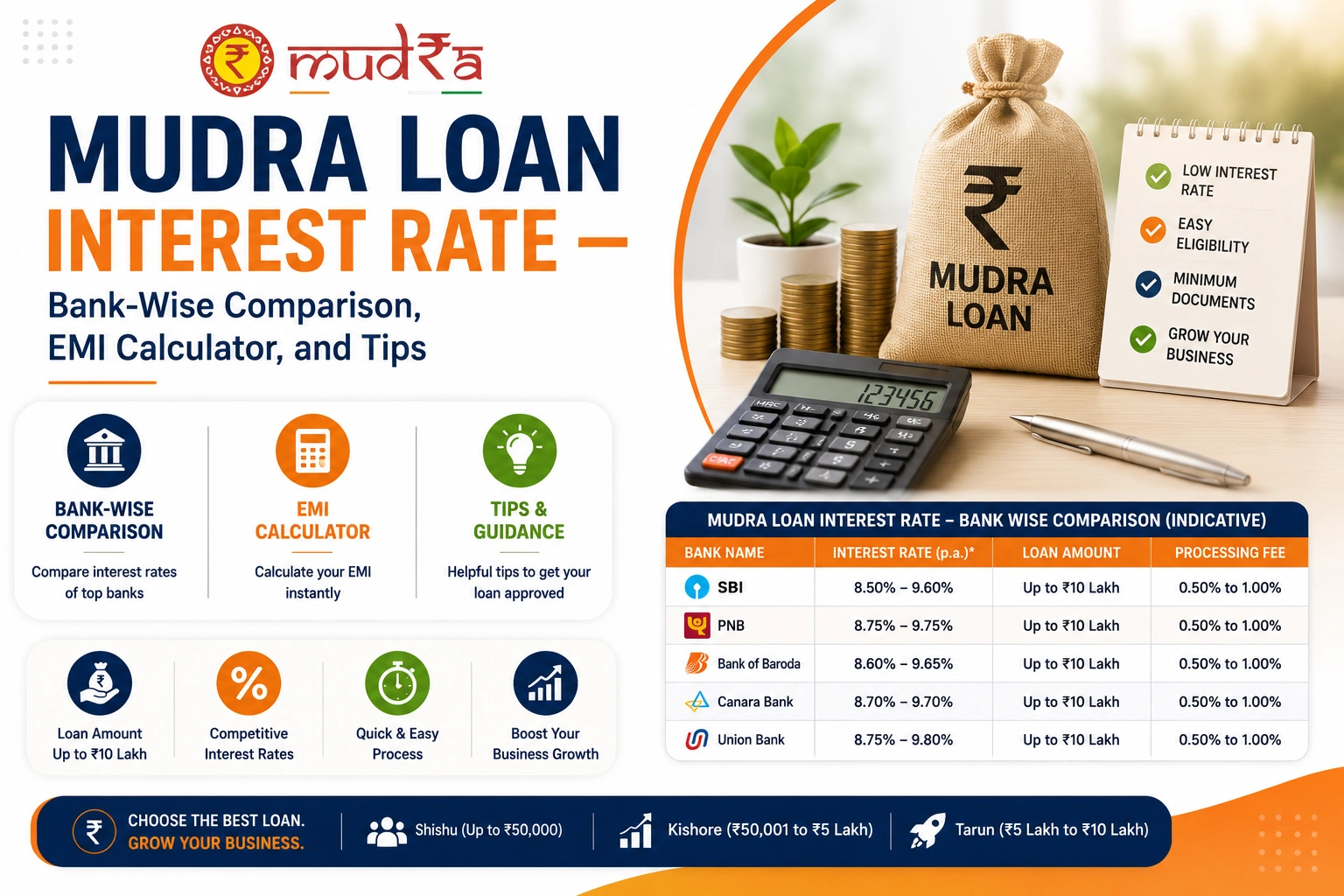
Mudra loan interest rates in 2026 range from 8.5% to 24% per annum depending on the lender, loan category, and borrower profile. Public sector banks offer the lowest rates — SBI, Canara Bank, and Bank of Baroda typically quote between 8.5% and 11% for Shishu and Kishore categories. Private banks like HDFC and ICICI charge 10% to 13%. Small Finance Banks and NBFCs charge 14% to 24% but have more flexible eligibility norms. Mudra loan interest rates are not fixed by the government — each lender sets its own rate based on the borrower’s CIBIL score, business vintage, and loan category. There is no interest subsidy under Mudra, unlike PMEGP.
Source: PMMY Official Guidelines — mudra.org.in | RBI MSME Lending Directions 2026
Key Takeaways
✅ Government does not fix Mudra loan interest rates — each bank sets its own rate independently; shopping across lenders before applying can save you thousands over the loan tenure
✅ PSU banks offer the lowest rates — 8.5% to 11% — SBI, Bank of Baroda, Canara Bank, and PNB consistently beat private banks for Mudra loan pricing
✅ Shishu rates are lower than Tarun rates — smaller loan amounts carry less risk for the bank; a Rs.50,000 Shishu loan typically gets a better rate than a Rs.10 lakh Tarun loan
✅ A strong project report directly affects your interest rate — it signals low default risk to the bank and gives you negotiating leverage for a better rate
✅ No interest subsidy under Mudra — unlike PMEGP where 15-35% of the principal is forgiven, Mudra loans must be fully repaid with interest; if subsidy matters, compare PMEGP first
Vikram’s Story — Two Banks, Same Application, Rs.1.2 Lakh Difference
Vikram Nair, 29, from Coimbatore, Tamil Nadu, needed Rs.8 lakh to expand his mobile accessories wholesale business. He walked into HDFC Bank first — the bank where he had his savings account — and was quoted 12.5% interest on a Mudra Tarun loan.
Before signing anything, a fellow entrepreneur in his area suggested he try the nearest SBI branch.
SBI quoted him 10.25% on the same Rs.8 lakh for the same 5-year tenure.
Same loan. Same applicant. Same documents.
The difference: Rs.8 lakh at 12.5% for 5 years costs Rs.2,83,000 in total interest. The same loan at 10.25% costs Rs.2,26,400. That is Rs.56,600 saved — just by making one additional visit before signing.
Vikram applied at SBI, submitted his project report from MudraReady, and was approved in 23 days.
Mudra loan interest rates are not uniform. Comparing lenders before you commit is not optional — it is the single most impactful financial decision in the application process.
Why Mudra Loan Interest Rates Are Not Fixed
A common misconception is that the government sets a uniform interest rate for Mudra loans. It does not.
MUDRA (Micro Units Development & Refinance Agency) provides refinance support to lending institutions — banks, RRBs, Small Finance Banks, NBFCs, and MFIs. Each of these institutions then lends to borrowers at their own internally determined rates.
These rates are linked to the lender’s benchmark — either RLLR (Repo Rate Linked Lending Rate) or MCLR (Marginal Cost of Funds Based Lending Rate) — plus a spread that reflects the lender’s assessment of risk.
What this means for you:
- Two banks can quote very different rates for identical applications
- Rates can change when RBI changes the repo rate
- RLLR-linked loans benefit from RBI rate cuts — MCLR-linked loans adjust more slowly
- Always ask the bank which benchmark your loan is linked to
Bank-Wise Mudra Loan Interest Rates — 2026 Comparison
| Bank | Shishu (up to Rs.50K) | Kishore (Rs.50K-5L) | Tarun (Rs.5L-10L) | Tarun Plus (Rs.10L-20L) |
| State Bank of India (SBI) | 8.5% – 9.5% | 9% – 10% | 9.5% – 10.5% | 11% – 12% |
| Canara Bank | 8.5% – 10% | 9% – 10.5% | 9.5% – 11% | 11% – 12.5% |
| Bank of Baroda | 8.75% – 10% | 9% – 10.5% | 9.5% – 11% | 11% – 12.5% |
| Punjab National Bank | 8.75% – 10% | 9% – 11% | 9.5% – 11% | 11% – 13% |
| Union Bank of India | 8.75% – 10.5% | 9% – 11% | 10% – 11.5% | 11.5% – 13% |
| Indian Bank | 9% – 10.5% | 9.5% – 11% | 10% – 12% | 12% – 13.5% |
| UCO Bank | 9% – 11% | 9.5% – 11.5% | 10% – 12% | 12% – 14% |
| Bank of Maharashtra | 9% – 10.5% | 9.5% – 11% | 10% – 12% | 12% – 13.5% |
| HDFC Bank | 10% – 12% | 11% – 12.5% | 11% – 13% | 13% – 15% |
| ICICI Bank | 10% – 12% | 11% – 13% | 11% – 13% | 13% – 15% |
| Axis Bank | 10% – 12% | 11% – 13% | 11% – 13% | 13% – 15% |
| Equitas Small Finance Bank | 14% – 17% | 15% – 18% | 16% – 19% | N/A |
| Ujjivan Small Finance Bank | 14% – 18% | 15% – 19% | 16% – 20% | N/A |
| NBFCs / MFIs | 18% – 24% | 18% – 24% | 18% – 24% | N/A |
Note: These are indicative ranges based on published data for FY 2025-26. Final rates are determined by each bank based on individual borrower assessment. Always confirm the current rate with the bank before applying. Rates change when RBI adjusts the repo rate.
What Determines the Interest Rate Offered to You
Banks do not offer a single rate to everyone. Your specific rate within the range above depends on five factors:
Factor 1 — CIBIL Score
| CIBIL Score | Rate Impact |
| 750 and above | Best available rate within the range — bottom of the band |
| 700 to 749 | Near-best rate — small premium |
| 650 to 699 | Mid-range rate |
| 600 to 649 | Higher end of the range — if approved at all |
A CIBIL score of 750+ at SBI could get you 9.5% on a Tarun loan. A score of 650 at the same bank on the same loan could get you 10.5% — a difference of 1% that on Rs.10 lakh over 5 years costs an additional Rs.28,000.
Factor 2 — Loan Category
Shishu loans carry less risk for the bank — smaller amounts, shorter recovery time. Banks price this lower. Tarun Plus loans at Rs.10-20 lakh carry more risk and are priced higher. As a general rule:
Shishu < Kishore < Tarun < Tarun Plus in terms of interest rate.
Factor 3 — Business Vintage
A business that has been operating for 2-3 years with documented turnover is a lower risk than a brand-new startup. Established businesses with Udyam registration, GST filing history, and a clean bank account typically get better rates than new applicants with no track record.
Factor 4 — Banking Relationship
If you already hold a savings or current account at the bank you are applying to, the bank has your transaction history. It can see your average balance, inflow patterns, and payment behaviour. This visibility reduces perceived risk and often results in a better rate — typically 0.25% to 0.5% lower than what a new-to-bank applicant would get.
Factor 5 — Project Report Quality
A well-prepared project report with a DSCR of 1.4 or above — clearly showing the business can comfortably service the loan — signals a low-risk borrower. Banks use the project report as a proxy for financial discipline. A weak or missing project report often results in the bank pricing the loan at the higher end of its range.
Build a project report that gives you negotiating leverage: mudraready.in/mudra-loan-project-report — Rs.399, first report free.
EMI Calculation — Real Numbers Across Rate Scenarios
Use this to understand the true cost of different interest rates before you walk into a bank.
Rs.3 Lakh Kishore Loan — 5 Year Tenure
| Interest Rate | Monthly EMI | Total Interest Paid | Total Amount Paid |
| 9% (SBI best case) | Rs.6,228 | Rs.73,680 | Rs.3,73,680 |
| 10% (SBI standard) | Rs.6,374 | Rs.82,440 | Rs.3,82,440 |
| 11% (PSU mid-range) | Rs.6,524 | Rs.91,440 | Rs.3,91,440 |
| 13% (Private bank) | Rs.6,833 | Rs.1,09,980 | Rs.4,09,980 |
| 18% (NBFC) | Rs.7,617 | Rs.1,57,020 | Rs.4,57,020 |
Choosing SBI at 9% over an NBFC at 18% on a Rs.3 lakh loan saves Rs.83,340 over 5 years.
Rs.8 Lakh Tarun Loan — 5 Year Tenure
| Interest Rate | Monthly EMI | Total Interest Paid | Total Amount Paid |
| 9.5% (PSU best case) | Rs.16,768 | Rs.2,06,080 | Rs.10,06,080 |
| 10.5% (PSU standard) | Rs.17,189 | Rs.2,31,340 | Rs.10,31,340 |
| 11% (PSU high end) | Rs.17,404 | Rs.2,44,240 | Rs.10,44,240 |
| 12.5% (Private bank) | Rs.18,071 | Rs.2,84,260 | Rs.10,84,260 |
Difference between 9.5% and 12.5% on Rs.8 lakh over 5 years: Rs.78,180.
Rs.15 Lakh Tarun Plus Loan — 7 Year Tenure
| Interest Rate | Monthly EMI | Total Interest Paid | Total Amount Paid |
| 11% (PSU) | Rs.25,477 | Rs.6,40,036 | Rs.21,40,036 |
| 12% (PSU high / Private low) | Rs.26,214 | Rs.7,01,976 | Rs.22,01,976 |
| 14% (Private bank) | Rs.27,730 | Rs.8,29,320 | Rs.23,29,320 |
At 14% vs 11% on Rs.15 lakh over 7 years — you pay Rs.1,89,284 extra.
Calculate your exact EMI: mudraready.in/business-loan-emi-calculator
Mudra Loan Interest Rate vs PMEGP — The Comparison That Matters Most
If you are starting a new business and thinking only about Mudra loan interest rates, you may be missing the bigger picture.
PMEGP does not reduce your interest rate — it eliminates a portion of your principal forever.
| Mudra Tarun Rs.10 lakh | PMEGP Rs.10 lakh (25% urban subsidy) | |
| Own contribution | Rs.1,00,000 (10%) | Rs.50,000 (5%) |
| Government subsidy | Zero | Rs.2,50,000 — never repaid |
| Bank loan | Rs.9,00,000 | Rs.7,00,000 |
| Monthly EMI (10.5%, 5 years) | Rs.19,337 | Rs.15,040 |
| Total interest over 5 years | Rs.2,60,220 | Rs.2,02,400 |
| Total cost of funding | Rs.10,00,000 + Rs.2,60,220 | Rs.7,00,000 + Rs.2,02,400 + Rs.50,000 own |
For a new business needing Rs.10 lakh, PMEGP saves Rs.2,50,000 in principal — which no interest rate difference on a Mudra loan can compensate for.
The trade-off: PMEGP takes 45-90 days; Mudra takes 15-30 days. If time is critical, Mudra wins. If you can wait and are starting fresh, PMEGP is worth the wait.
Full PMEGP guide: mudraready.in/blog/pmegp-loan-kaise-milega-2026
SC/ST and Women — Interest Rate Benefits
Mudra loan interest rates do not formally differ based on gender or caste — the scheme is uniform. However, some specific concessions exist:
| Category | Benefit | Bank |
| Women Entrepreneurs | 0.25% – 0.5% concession at select banks | SBI, Bank of Maharashtra |
| SC/ST | Some banks offer priority processing — not rate reduction | PSU banks generally |
| All Categories | Existing account relationship gives better rate | All banks |
Women starting new businesses above Rs.5 lakh: Compare PMEGP before Mudra — 25-35% subsidy on principal makes the effective cost far lower than any interest rate difference. Guide: mudraready.in/pmegp-project-report
Processing Fee and Other Charges
Interest rate is not the only cost. Banks charge additional fees that affect the total cost of your loan.
| Charge | PSU Banks | Private Banks | Small Finance Banks |
| Processing Fee | 0% – 0.5% of loan amount | 0.5% – 2% | 1% – 2% |
| Prepayment Penalty | Usually nil for MSMEs | 2% – 4% | 2% – 5% |
| Late Payment Penalty | 2% per month on overdue | 2% – 3% | 3% |
| Documentation Charges | Minimal | Rs.500 – Rs.2,000 | Rs.500 – Rs.1,500 |
PSU banks are significantly cheaper on fees in addition to rates. A private bank quoting 11% with 2% processing fee on a Rs.5 lakh loan costs Rs.10,000 upfront + higher EMI. An SBI loan at 10% with 0.25% processing costs Rs.1,250 upfront + lower EMI.
Always calculate the total cost of borrowing — not just the interest rate headline.
6 Practical Tips to Get the Lowest Mudra Loan Interest Rate
1. Apply at your existing account bank first The bank where you have a savings or current account already knows your transaction behaviour. Existing customers consistently get 0.25%-0.5% better rates than new customers.
2. Choose PSU banks over private banks For Mudra loans specifically, PSU banks have lower rates and are more aligned with the government’s financial inclusion mandate. Start with SBI, Bank of Baroda, or PNB before approaching private banks.
3. Build your CIBIL score to 700+ before applying Every 50-point improvement in CIBIL score can move you from the mid-range to the lower end of the interest rate band. A score of 700 vs 650 on a Rs.8 lakh Tarun loan can save Rs.20,000-30,000 over the full tenure.
4. Submit a strong project report with DSCR 1.4+ A project report showing a DSCR of 1.4 or above — clearly demonstrating the business can service the loan — gives the bank confidence to price the loan lower. It also speeds up processing. MudraReady generates reports with DSCR guaranteed at 1.25 and above.
5. Request RLLR-linked pricing if RBI is cutting rates Ask the bank whether your loan will be RLLR-linked (Repo Rate Linked Lending Rate) or MCLR-linked. RLLR-linked loans pass on RBI rate cuts to you within 3 months — MCLR-linked loans are slower to adjust. In a rate-cutting environment, RLLR is preferable.
6. Use jansamarth.in to compare multiple lenders simultaneously One application on jansamarth.in reaches 254+ lenders. You receive offers from multiple institutions and can compare rates before committing. This is the most efficient way to ensure you are getting a competitive rate.
5 Real Cases — How Interest Rate Decisions Played Out
Case 1 — Priya Menon, Kochi (Beauty Parlour, Rs.3 Lakh Kishore)
Applied at Federal Bank (private) — quoted 13.5%. Went to Canara Bank next — quoted 10%. Chose Canara Bank. Saved Rs.63,000 over 5 years on a Rs.3 lakh loan. Lesson: One additional bank visit before signing saved more money than six months of business revenue growth.
Case 2 — Ajay Tomar, Lucknow (Flour Mill, Rs.9 Lakh Tarun)
Had CIBIL 642. Walked into SBI and was quoted 12% — top of the range for his score. Cleared a Rs.4,500 old credit card default. Score went to 688 in 45 days. Reapplied at SBI — quoted 10.5%. Saved Rs.41,000 over 5 years. Lesson: Fixing CIBIL before applying directly reduces the interest rate offered.
Case 3 — Renu Sharma, Jaipur (Kirana Store, Rs.5 Lakh Kishore)
Applied at Ujjivan Small Finance Bank (18%) because she thought PSU banks would reject her CIBIL 661. Bank of Baroda approved her at 10.25%. She had assumed wrong. Lesson: Do not assume PSU banks will reject a score of 650-680. Apply there first — the assumption of rejection costs money.
Case 4 — Sandeep Kulkarni, Pune (Mobile Repair Chain, Rs.18 Lakh Tarun Plus)
First applied at ICICI Bank — quoted 14.5%. Went to SBI with the same application and project report — quoted 11.5%. Difference: Rs.1,87,200 over 7 years. Lesson: On large Tarun Plus loans, the rate gap between PSU and private banks becomes very significant. Always compare.
Case 5 — Geetha Nair, Chennai (Catering Business, Rs.4 Lakh Kishore)
Was about to sign at 12% at a private bank. Bank manager mentioned she could negotiate — she had a CIBIL of 724 and a strong MudraReady project report showing DSCR 1.68. She asked for a better rate — got 10.25%. Lesson: Interest rates on Mudra loans are sometimes negotiable — especially when your CIBIL and project report are strong. Ask explicitly for a rate reduction before signing.
Moratorium Period — How It Affects Your Total Interest Cost
Most borrowers focus only on the interest rate — but the moratorium period (the initial months where you pay only interest, not principal) significantly affects your total interest outgo.
| Moratorium | Effect on Total Interest | Best For |
| No moratorium | Lowest total interest — principal reduces from month 1 | Businesses generating revenue immediately |
| 3-month moratorium | Moderate increase — interest accrues on full principal for 3 months | Most small businesses — time to set up |
| 6-month moratorium | Higher total interest — but lower pressure in early months | Seasonal businesses, manufacturing setup |
Real example — Rs.5 lakh Kishore at 10%, 5 years:
- Without moratorium: Total interest = Rs.1,37,480
- With 3-month moratorium: Interest during moratorium = Rs.12,500 added to principal, then EMI on Rs.5,12,500 — total interest approximately Rs.1,52,000
Moratorium adds cost — but reduces early-stage stress. For a new business that needs 2-3 months to start generating revenue, a 3-month moratorium is often worth the additional Rs.14,000-15,000 in total interest. For an established business expanding with immediate new revenue, skip the moratorium and reduce total cost.
Always ask your bank about moratorium options before finalising the loan structure.
DSCR and Its Connection to Interest Rate
Your DSCR (Debt Service Coverage Ratio) affects both loan approval and the interest rate offered.
Formula:
DSCR = (Net Annual Profit + Annual Depreciation + Annual Term Loan Interest)
÷ (Annual EMI + Annual Term Loan Interest)
Minimum required:
- Service businesses: 1.25
- Manufacturing businesses: 1.50
How DSCR affects your rate: A DSCR of 1.25 — just at the minimum — tells the bank the business barely covers the loan. The bank prices this as higher risk. A DSCR of 1.6 or 1.7 tells the bank the business comfortably covers the loan with significant buffer. This is lower risk — and lower risk gets better pricing.
Check your DSCR before walking into any bank: mudraready.in/dscr-calculator
10 Frequently Asked Questions — Mudra Loan Interest Rate 2026
Q1. What is the interest rate on Mudra loan in 2026? Mudra loan interest rates in 2026 are not fixed by the government — each lender sets its own rate. Public sector banks like SBI, Bank of Baroda, and Canara Bank typically quote 8.5% to 11% for Shishu and Kishore categories and 9.5% to 11% for Tarun. Private banks charge 10% to 13%. Small Finance Banks and NBFCs charge 14% to 24%. The final rate depends on your CIBIL score, loan category, business vintage, and banking relationship. Apply at your existing bank first, then compare with at least two other lenders before deciding.
Q2. Which bank offers the lowest Mudra loan interest rate in 2026? SBI and PNB consistently offer the most competitive Mudra loan rates among major lenders — typically 9.5% to 10.5% for Tarun loans for borrowers with a CIBIL score of 700 and above. Canara Bank and Bank of Baroda are close behind. Among private banks, rates start higher at 10% to 12%. For the best comparison, apply through jansamarth.in where multiple lenders compete for your application simultaneously.
Q3. Is there a government subsidy on Mudra loan interest? No — there is no interest subsidy under Mudra. The full principal and interest must be repaid. This is a key difference from PMEGP, where 15% to 35% of the project cost is given as a non-repayable subsidy (margin money). If you are starting a new business and want a subsidy, PMEGP is worth comparing: mudraready.in/blog/pmegp-loan-kaise-milega-2026
Q4. What is the Mudra loan interest rate at SBI in 2026? SBI’s indicative Mudra loan interest rates for FY 2025-26: Shishu 8.5%-9.5%, Kishore 9%-10%, Tarun 9.5%-10.5%, Tarun Plus 11%-12%. The final rate is determined by the borrower’s CIBIL score, business vintage, and relationship with the bank. Existing SBI account holders with a CIBIL score of 700 and above typically get the lower end of these ranges. Confirm the current rate directly with your SBI branch as rates are linked to the repo rate and change when RBI adjusts monetary policy.
Q5. What is the Mudra Tarun Plus interest rate? Tarun Plus (Rs.10 lakh to Rs.20 lakh) carries slightly higher rates than standard Tarun loans due to the larger loan size. PSU banks typically quote 11% to 13% for Tarun Plus. Private banks quote 13% to 15%. The loan is 100% collateral-free under CGFMU coverage. Tarun Plus is only available to borrowers who have already fully repaid a previous Tarun loan — first-time borrowers cannot access this category. A strong project report is essential for Tarun Plus approval and better pricing.
Q6. Can I negotiate the Mudra loan interest rate with a bank? Yes — in many cases you can. Banks have a rate range, not a fixed rate, for each category. If your CIBIL score is 700 or above and your project report shows a DSCR of 1.5 or higher, you are a low-risk borrower. Banks want to retain such customers. Explicitly ask the branch manager for the best available rate for your profile. Having a competing offer from another bank strengthens your position. Negotiation is most effective on Kishore and Tarun loans above Rs.3 lakh.
Q7. Does the Mudra loan interest rate change during the loan tenure? It depends on whether your loan is RLLR-linked or MCLR-linked. RLLR (Repo Rate Linked Lending Rate) loans reset every 3-6 months based on RBI’s repo rate changes — when RBI cuts rates, your EMI or tenure reduces. MCLR-linked loans reset less frequently and may not immediately reflect rate cuts. Ask your bank explicitly which benchmark your loan will be linked to. In a period where RBI is cutting rates, RLLR-linked pricing is better for the borrower.
Q8. What is the processing fee for a Mudra loan? PSU banks typically charge 0% to 0.5% of the loan amount as processing fee — often nil for Shishu and nominal for Kishore and Tarun. Private banks charge 0.5% to 2%. Small Finance Banks and NBFCs charge 1% to 2%. On a Rs.5 lakh Kishore loan at a private bank with 2% processing fee, that is Rs.10,000 paid upfront before a single EMI. Factor in processing fees when comparing the true cost across lenders — the headline interest rate alone does not tell the full story.
Q9. What happens to the Mudra loan interest rate if I prepay the loan? For MSME borrowers, RBI guidelines discourage prepayment penalties — most PSU banks levy nil or nominal prepayment charges on Mudra loans. Private banks may charge 2% to 4% of the outstanding principal. If you plan to repay early — for instance, if your business grows faster than projected — confirm the prepayment terms with the bank before signing. Prepayment at PSU banks is generally straightforward and cost-free.
Q10. How does a strong project report affect my Mudra loan interest rate? A project report with a DSCR of 1.4 or above signals to the bank that your business generates more than enough revenue to service the loan comfortably. Banks price lower-risk borrowers at the lower end of their rate range. A weak or missing project report — or one with unrealistic projections — signals risk, and banks respond with higher rates or outright rejection. MudraReady builds project reports with DSCR guaranteed at 1.25 and above — giving you both an approval edge and a rate negotiation tool.
Vikram Today — and Your Next Step
Vikram Nair’s wholesale accessories business in Coimbatore is in its second year. Revenue has grown from Rs.3.8 lakh per month to Rs.6.2 lakh. The EMI at SBI’s 10.25% is comfortable — Rs.17,189 per month on the Rs.8 lakh loan.
That one additional visit — from HDFC to SBI — saved him Rs.56,600 over the tenure of his loan.
The right rate is not found by accepting the first offer. It is found by comparing.
Your next step:
- Calculate your EMI across rate scenarios: mudraready.in/business-loan-emi-calculator
- Check your DSCR: mudraready.in/dscr-calculator
- Build a project report that gives you rate negotiation leverage: mudraready.in/mudra-loan-project-report — Rs.399, first report free
- Compare multiple lenders in one application: jansamarth.in
Build your bank-ready Mudra loan project report in 10 minutes. Rs.399. First report completely free.
Related Guides
- Mudra Loan Eligibility 2026 — Who Can Apply
- Mudra Loan Project Report — How to Build One
- Why Mudra Loan Gets Rejected — 7 Reasons and Fixes
- PMEGP — 15-35% Subsidy for New Businesses
- DSCR — What It Is and Why Banks Use It
- SBI Mudra Loan — Complete Guide
- CGTMSE — Collateral Free Loan for Larger Amounts
- EMI Calculator — Free
- DSCR Calculator — Free
- Mudra vs PMEGP vs CGTMSE — Full Comparison
- Apply Online: jansamarth.in
Sources
- PMMY Official Portal: mudra.org.in
- RBI MSME Lending Directions 2026: rbi.org.in
- BankBazaar Mudra Loan Interest Rate Data — bankbazaar.com
- MudraGen Interest Rate Comparison Tool 2026 — mudragen.com
- Bajaj Finserv Mudra Loan Rate Guide — bajajfinserv.in
Last Updated: August 2026
Focus Keyword: mudra loan interest rate Secondary Keywords: mudra loan interest rate 2026, mudra loan interest rate SBI, mudra loan bank wise interest rate, mudra tarun loan interest rate, mudra loan processing fee, lowest mudra loan interest rate Meta Title (56 chars): Mudra Loan Interest Rate 2026 — Bank-Wise Comparison Meta Description: Mudra loan interest rates in 2026 range from 8.5% to 24%. Compare SBI, PNB, BOB, HDFC rates for Shishu, Kishore, Tarun, and Tarun Plus with real EMI calculations. (163 chars — trim to 155)