Sunita lives in a slum in Bhopal. She makes pickles at home — mango, lemon, mixed vegetables. Her neighbours buy from her. Some regular customers call to place orders.
She wanted to formalise — a small production unit, proper packaging, supply to local shops. She needed Rs.1.5 lakh for equipment and packaging materials.
Every bank she approached asked the same questions — income proof, ITR, collateral. She had none of these.
Then a municipal corporation worker mentioned DAY-NULM.
She joined an urban Self Help Group through her local municipality. The group applied together for a DAY-NULM loan. The group of 5 women received Rs.5 lakh collectively — Rs.1 lakh each. Interest rate: 7% per annum. No collateral. No ITR required.
Sunita bought a commercial mixer, glass jars, professional labels, and a sealing machine. Her pickle business now supplies 3 local grocery stores.
This guide explains everything about DAY-NULM — what it is, who qualifies, how much you can get, how the interest subsidy works, how to apply through your municipality, and how to combine it with Mudra loan for larger funding.
Quick Answer — DAY-NULM Loan 2026
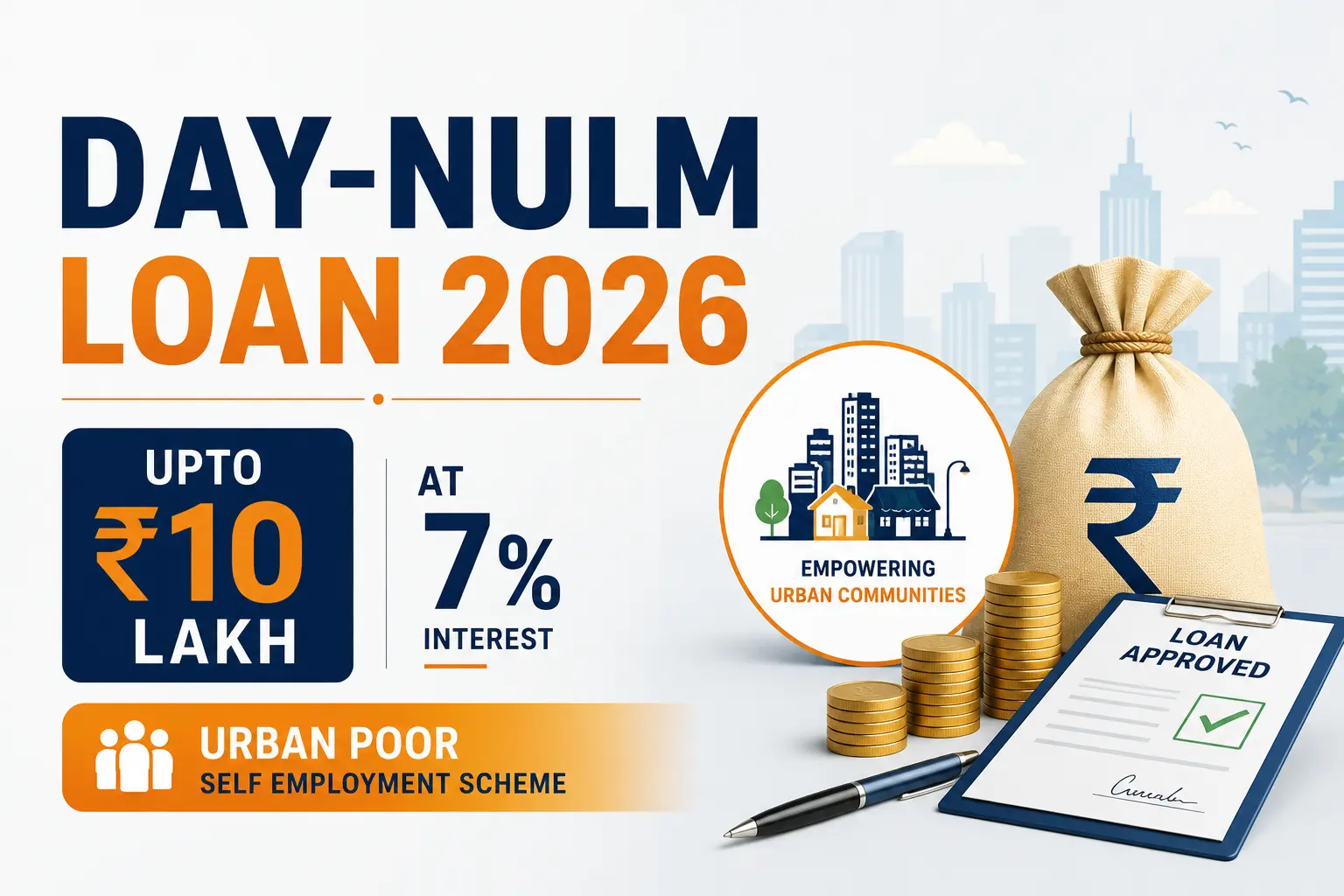
DAY-NULM (Deendayal Antyodaya Yojana — National Urban Livelihoods Mission) provides interest-subsidised loans to the urban poor for self-employment. Individual loans up to Rs.2 lakh at 7% effective interest. Group loans up to Rs.10 lakh at 7% (with additional 3% rebate for women SHGs who repay on time — effective rate 4%). No collateral required. No minimum educational qualification. Implemented through Urban Local Bodies (municipal corporations) across all district headquarters and cities with population above 1 lakh. Source: nulm.gov.in and Ministry of Housing and Urban Affairs
What You Will Learn in This Guide:
✅ What DAY-NULM is — and why it is different from Mudra and PMEGP
✅ Individual loan vs SHG group loan — how each works with real numbers
✅ Interest subsidy — exactly how 7% works and the additional 3% rebate for women
✅ Who qualifies — urban poor identification, BPL, and ULB lists
✅ How to join an urban SHG through your municipality
✅ Step-by-step application process through the City Mission Management Unit
✅ Real income examples — what businesses DAY-NULM typically funds
✅ How to combine DAY-NULM with Mudra loan for larger funding
✅ All schemes compared — DAY-NULM vs Mudra vs PMEGP vs Stand Up India
✅ 5 real rejection cases with exact fixes
✅ 10 FAQs — every question first-time applicants ask
Table of Contents
What Is DAY-NULM Loan Scheme— And Why It Exists
DAY-NULM stands for Deendayal Antyodaya Yojana — National Urban Livelihoods Mission. It is a Government of India scheme launched in September 2013 by the Ministry of Housing and Urban Affairs (MoHUA), designed specifically to reduce poverty among India’s urban poor.
The mission operates on a fundamental insight: most government loan schemes — Mudra, PMEGP, CGTMSE — require some level of formal documentation, credit history, or business registration that the very poorest urban residents simply do not have. A street vendor, a home-based pickle maker, a slum-dwelling tailor — these people have skills and work ethic but no ITR, no credit history, no formal business address.
DAY-NULM was created to fill this gap.
According to nulm.gov.in, DAY-NULM is currently active in all district headquarters across India and all cities with population above 1 lakh. It operates through Urban Local Bodies — municipal corporations — making it accessible at the grassroots level.
DAY-NULM — Key Facts 2026:
| Feature | Details |
|---|---|
| Full Name | Deendayal Antyodaya Yojana — National Urban Livelihoods Mission |
| Launched | September 2013 |
| Run By | Ministry of Housing and Urban Affairs (MoHUA) |
| Implemented Through | Urban Local Bodies — municipal corporations |
| Individual Loan Maximum | Rs.2,00,000 |
| Group Loan Maximum | Rs.10,00,000 (Rs.2L per member) |
| Interest Rate | 7% effective (government subsidises the rest) |
| Women SHG Rebate | Additional 3% for timely repayment — effective 4% |
| Collateral | Not required |
| Educational Qualification | None required |
| Target Beneficiary | Urban poor — BPL families and ULB-identified poor |
| Official Portal | nulm.gov.in |
Two Loan Types — Individual and SHG Group
DAY-NULM offers two distinct loan structures. Understanding the difference determines which one you should apply for.
Type 1 — Individual Micro-Enterprise Loan (SEP-I):
For individuals from urban poor families who want to start or expand a small business. Loan amount up to Rs.2 lakh. No collateral required for loans up to Rs.50,000 — for amounts above Rs.50,000, preferably 5% margin money is taken (not more than this in any case). No guarantor needed.
Type 2 — Group Enterprise Loan (SEP-G):
For a group of urban poor — minimum 3 members, maximum 70% must be from urban poor families. Maximum loan Rs.2 lakh per member or Rs.10 lakh total — whichever is lower. A group of 5 members can get up to Rs.10 lakh collectively. More than one person from the same family cannot be in the same group.
Type 3 — SHG Bank Linkage (SEP-SHG):
Self Help Groups formed under DAY-NULM can access credit from banks with interest subsidy. Women’s SHGs who repay regularly get an additional 3% interest rebate — making their effective rate 4% per annum. This is the most powerful component for women’s groups.
Comparison — individual vs group:
| Feature | Individual (SEP-I) | Group (SEP-G) | SHG (SEP-SHG) |
|---|---|---|---|
| Who Applies | Single urban poor person | Group of 3+ urban poor | Registered SHG under DAY-NULM |
| Maximum Loan | Rs.2 lakh | Rs.10 lakh total | Varies — bank decides |
| Margin Money | None up to Rs.50,000 | None up to Rs.50,000 per member | None |
| Interest Rate | 7% effective | 7% effective | 7% — 4% for women SHGs |
| Processing | Through ULB — CMMU | Through ULB — CMMU | Through bank — ULB facilitates |
| Best For | Solo business — tailoring, vending | Shared production unit | Women’s group — pickle, handicraft, food |
How the Interest Subsidy Actually Works
This is the most misunderstood aspect of DAY-NULM — and most guides either skip it or explain it wrong.
The subsidy mechanism:
Banks lend at their standard interest rate — typically 10-14% per annum for small loans. DAY-NULM’s interest subsidy means the government pays the difference between the bank’s rate and 7%. So if the bank charges 12%, the government pays 5% — you pay only 7%.
Formula:
Effective Interest Paid by Borrower = 7% per annum
Government Subsidy = Bank’s Rate minus 7%
Real example — Sunita’s Rs.1 lakh loan:
| Item | Without DAY-NULM | With DAY-NULM |
|---|---|---|
| Bank’s standard rate | 12% per annum | 12% per annum |
| Government subsidy | None | 5% per annum |
| What Sunita pays | 12% = Rs.12,000/year | 7% = Rs.7,000/year |
| Annual saving | — | Rs.5,000 per year |
| 5-year saving | — | Rs.25,000 |
The women SHG additional rebate:
Women’s Self Help Groups under DAY-NULM who maintain prompt repayment — no defaults, no delays — receive an additional 3% interest subvention. This reduces their effective interest rate to 4% per annum. At 4%, a Rs.5 lakh group loan saves approximately Rs.40,000 in interest over 5 years compared to a standard 12% loan.
Monthly EMI comparison — Rs.1 lakh loan:
| Loan Type | Interest Rate | Monthly EMI (5 years) | Total Interest Paid |
|---|---|---|---|
| Standard bank loan | 12% | Rs.2,224 | Rs.33,440 |
| DAY-NULM individual | 7% | Rs.1,980 | Rs.18,800 |
| DAY-NULM women SHG | 4% | Rs.1,842 | Rs.10,520 |
The DAY-NULM women SHG loan saves Rs.22,920 over 5 years on a Rs.1 lakh loan — purely from the interest subsidy. On a Rs.5 lakh group loan, the saving over 5 years is Rs.1,14,600.
Use MudraReady’s free EMI Calculator to calculate your exact repayment schedule.
Who Qualifies — Urban Poor Identification
Basic eligibility:
✅ Urban poor — resident of a city or town with population above 1 lakh or any district headquarters
✅ Identified as urban poor by the Urban Local Body (ULB) — municipal corporation
✅ BPL (Below Poverty Line) card holder — OR identified by ULB’s poverty survey
✅ Street vendors and hawkers — specifically included
✅ Age 18 years or above
✅ No minimum educational qualification required
✅ No minimum CIBIL score specified
Who is “urban poor” in this context:
The term is broader than just BPL cardholders. DAY-NULM identifies beneficiaries through Urban Local Body surveys and the DRDA poverty line list for rural beneficiaries — applicants with a poverty score of 0 to 16 are not required to submit an income certificate. If you live in an urban slum, low-income neighbourhood, or are a street vendor — you likely qualify even without a formal BPL card. Your municipal corporation’s Community Organiser or City Mission Management Unit (CMMU) can verify your eligibility.
Who is NOT eligible:
❌ Rural residents — DAY-NULM is specifically for urban areas. Rural residents should apply for DAY-NRLM (National Rural Livelihoods Mission)
❌ People above the urban poverty line who have formal income and assets
❌ Government employees
❌ People who have already defaulted on previous government scheme loans without resolution
How to Join an Urban SHG
For group loans and SHG bank linkage — the most powerful DAY-NULM components — you must be a member of a registered urban SHG under DAY-NULM.
What is an urban SHG under DAY-NULM:
A Self Help Group of 10-20 members — mostly women — from urban poor families. The group meets regularly, pools small savings (Rs.20-100 per month per member), and builds a credit history with the bank. After demonstrating regular saving and group management, the SHG becomes eligible for bank linkage and DAY-NULM loans.
How to find or form an SHG:
Step 1 — Visit your nearest municipal corporation office. Ask for the City Mission Management Unit (CMMU) or the Urban Livelihoods Mission desk. Every municipal corporation in cities above 1 lakh has this.
Step 2 — Tell them you want to join an existing urban SHG or form a new one for self-employment. They will connect you with existing groups in your area or help you form a new group with your neighbours.
Step 3 — Join the group. Start saving regularly — even Rs.20-50 per month. Attend group meetings. Keep records.
Step 4 — After 3-6 months of regular saving and group management, the group becomes eligible for bank linkage and DAY-NULM loan application.
For individual loans — SHG membership is not required. You can apply directly through the CMMU for an individual loan up to Rs.2 lakh.
How to Apply — Step by Step Through Your Municipality
Step 1 — Identify your City Mission Management Unit (CMMU)
Go to your nearest municipal corporation or municipality office. Ask for the DAY-NULM desk or City Mission Management Unit. This is the nodal agency for all DAY-NULM activities in your city. In large cities like Mumbai, Delhi, Bangalore — each ward has a community organiser.
Step 2 — Register as a beneficiary
CMMU staff will verify your urban poor status — through BPL card, Aadhaar address (must show an urban address), or ULB survey. After verification, you are registered as a DAY-NULM beneficiary.
Step 3 — Attend skill training (if required)
If your proposed business activity requires specific skills that you do not currently have, DAY-NULM’s Employment through Skills Training and Placement (EST&P) component provides free training through City Livelihood Centres. Training duration depends on the skill — typically 2-4 weeks.
Step 4 — Prepare your business plan
Even for DAY-NULM, banks require a project report before sanctioning the loan. The report for a Rs.2 lakh loan can be simpler than a full IBA-format report — but it must show: what business you will run, how much you will invest, how much you will earn monthly, and how you will repay the loan.
Generate your DAY-NULM project report at MudraReady — Rs.399, 10 minutes, first report FREE.
Step 5 — CMMU forwards your application to bank
The CMMU acts as facilitator — it verifies your application, confirms your urban poor status, and forwards the loan application to the designated bank branch. You do not need to navigate the bank independently.
Step 6 — Bank processes and sanctions
Bank reviews the application — CMMU verification acts as a significant endorsement. Processing time: 2-4 weeks for individual loans, 4-6 weeks for group loans.
Step 7 — Loan disbursement
Loan disbursed to your bank account. CMMU continues to provide follow-up support.
Documents required:
| Document | Purpose | Mandatory? |
|---|---|---|
| Aadhaar Card | Identity and address — must show urban address | Yes |
| BPL Card or ULB Poverty Certificate | Urban poor status proof | Yes — one of these |
| Bank Account (zero-balance acceptable) | For disbursement | Yes |
| Passport Size Photos | Application | Yes |
| Business Plan / Project Report | Loan purpose and repayment capacity | Yes |
| Residence Proof | Urban address confirmation | Yes |
| Caste Certificate | For SC/ST category benefits | If applicable |
| SHG Passbook | For group loan applications | For group loans |
What Businesses DAY-NULM Funds — Real Examples
DAY-NULM funds any viable micro-enterprise that an urban poor person can run. There is no negative list as restrictive as PMEGP.
Most commonly funded businesses:
| Business Type | Typical Loan | What It Funds |
|---|---|---|
| Home-based food processing | Rs.50,000 to Rs.1,50,000 | Mixer, jars, packaging, raw materials |
| Tailoring and garment | Rs.50,000 to Rs.1,00,000 | Sewing machine, overlock machine, materials |
| Beauty parlour | Rs.50,000 to Rs.2,00,000 | Basic equipment, products, rent deposit |
| Street vending | Rs.20,000 to Rs.50,000 | Cart, stock, storage |
| Vegetable/fruit vending | Rs.20,000 to Rs.50,000 | Cart, weights, cold box |
| Repair services | Rs.50,000 to Rs.1,00,000 | Tools, equipment |
| Handicraft production | Rs.50,000 to Rs.1,50,000 | Materials, tools |
| Candle/agarbatti making | Rs.30,000 to Rs.80,000 | Machine, raw materials |
Sunita’s pickle business — real income projection:
| Item | Monthly Amount (Rs.) |
|---|---|
| Pickle production — 200 jars at Rs.80 average selling price | 16,000 |
| Raw material cost — mangoes, spices, jars, labels | 6,000 |
| Packaging and transport | 1,500 |
| Electricity | 500 |
| Net Monthly Profit | 8,000 |
| DAY-NULM loan EMI (Rs.1L at 7% — 3 years) | 3,088 |
| Net After EMI | 4,912 |
DSCR = (Rs.8,000 × 12 + depreciation Rs.8,000 + interest Rs.4,900) ÷ (EMI Rs.37,056 + interest Rs.4,900) = Rs.1,08,900 ÷ Rs.41,956 = 2.60 ✅
Project Report for DAY-NULM Loan Scheme
Even though DAY-NULM is designed for the urban poor with minimal documentation, banks still require a basic project report before sanctioning any loan. The CMMU facilitates this — but having your own report ready speeds up the process significantly.
What your DAY-NULM project report must include:
| Section | What to Write |
|---|---|
| Applicant Profile | Name, address, ULB area, urban poor status, family income |
| Business Description | What you make or sell, who your customers are |
| Project Cost | Equipment, raw materials, working capital — itemised |
| Means of Finance | Own contribution + DAY-NULM loan amount |
| Monthly Income Projection | Revenue minus costs — realistic Year 1 estimate |
| DSCR Calculation | Minimum 1.25 — banks still check this |
| Repayment Plan | How you will repay monthly from business income |
DSCR minimum: Even for DAY-NULM loans at 7% — banks require DSCR of minimum 1.25. Check yours before applying: MudraReady’s free DSCR Calculator
How to Combine DAY-NULM With Mudra Loan
DAY-NULM and Mudra are complementary — not competing. Together they can fund a larger business than either scheme alone.
The combination strategy:
| Phase | Scheme | Amount | Purpose |
|---|---|---|---|
| Phase 1 | DAY-NULM Individual | Rs.1-2 lakh at 7% | Initial setup — equipment and stock |
| Phase 2 (after 12-18 months) | Mudra Kishor | Rs.2-5 lakh at market rate | Business expansion |
Why this sequence works:
DAY-NULM first establishes you as a borrower with a formal loan repayment track record. After 12-18 months of regular DAY-NULM repayment, your CIBIL score improves significantly. This makes Mudra loan approval faster and at better interest rates. A borrower with an existing clean loan repayment record is a much stronger Mudra applicant than a first-time borrower.
For SHG members — the combination is even more powerful:
SHG members who have been saving regularly and have group loan repayment history are considered premium borrowers by banks. Their Mudra loan approval rate is significantly higher than individual first-time applicants.
For complete Mudra loan guidance: Mudra Loan Project Report — Complete Guide
For PMEGP — if you are starting a new manufacturing business: PMEGP Loan Complete Guide 2026
All Schemes Compared — DAY-NULM vs Mudra vs PMEGP vs Stand Up India
| Feature | DAY-NULM | Mudra Loan | PMEGP | Stand Up India |
|---|---|---|---|---|
| Maximum Loan | Rs.2L (individual) / Rs.10L (group) | Rs.20 lakh | Rs.20 lakh (service) | Rs.1 crore |
| Interest Rate | 7% effective (4% women SHG) | 10-12% market rate | Market rate | MCLR + 3% |
| Government Subsidy | Interest subsidy only | None | 25-35% of project cost | None |
| Who Can Apply | Urban poor — BPL/ULB identified | Any Indian | Any Indian — new business | SC/ST and women only |
| Collateral | None | None | None up to Rs.10L | CGTMSE covers it |
| Minimum Education | None | None | None | None |
| Credit History | Not required — ULB endorsement replaces | Preferred but not mandatory | Not required | Preferred |
| Implemented Through | Municipal corporation | Banks directly | KVIC/DIC | Banks/standupmitra.in |
| Best For | Urban poor with no formal credit history | Any business — quick processing | New business with subsidy | SC/ST women — large enterprise |
| Processing Time | 2-6 weeks | 1-3 weeks | 2-4 months | 6-16 weeks |
Quick selection guide:
Urban poor — no credit history — need small loan → DAY-NULM — municipality is your ally
Any business — existing or new — quick funding → Mudra Loan
New manufacturing/service business — want subsidy → PMEGP
SC/ST or women — new enterprise above Rs.10L → Stand Up India
Already have DAY-NULM and want to expand → Mudra Loan next
5 Rejection Reasons With Real Cases and Fixes
Reason 1 — Applicant Is Not Identified as Urban Poor
What happened: Rajesh applied for DAY-NULM individual loan through his municipal corporation. He lived in a lower-middle-class neighbourhood — not technically a slum or BPL household. The CMMU officer could not classify him as urban poor. Application not processed.
The fix: DAY-NULM is specifically for people identified as urban poor by the ULB. If you are not BPL or not identified through a poverty survey — this scheme is not for you. Mudra Kishor with no collateral is better suited for lower-middle-class entrepreneurs. Do not try to misrepresent your status — verification is thorough.
Reason 2 — No Urban Address on Aadhaar
What happened: Fatima had recently moved from a village to a city for work. Her Aadhaar still showed her village address. The municipal corporation could not verify her as an urban resident. DAY-NULM application stuck.
The fix: Update your Aadhaar address to your current urban address before applying. Visit nearest Aadhaar Seva Kendra with proof of urban residence — rent agreement, utility bill, or employer letter showing city address. Address update takes 1-2 weeks. After update, reapply for DAY-NULM.
Reason 3 — Weak Project Report — DSCR Below 1.25
What happened: Meera applied for a Rs.1.5 lakh DAY-NULM individual loan for a home-based food processing unit. Her business plan was verbal — she described her business to the CMMU officer but had no written document. The bank the CMMU forwarded her application to asked for a project report. Meera submitted a handwritten 2-page document. Bank calculated DSCR as 0.92 — below minimum. Loan declined.
The fix: Even DAY-NULM requires a structured project report with DSCR calculation above 1.25. Generate a proper report at MudraReady — Rs.399, 10 minutes. The CMMU facilitates the process but cannot substitute for a bank-acceptable project report.
Reason 4 — SHG Not Properly Registered Under DAY-NULM
What happened: A group of women had been running an informal savings group in their neighbourhood for 2 years. They approached the municipal corporation for a DAY-NULM group loan. The group was not registered under DAY-NULM — it was an informal chit fund. The CMMU could not process the loan for an unregistered group.
The fix: For group loans, the SHG must be formally registered under DAY-NULM through the CMMU. Approach your CMMU first, register your group formally, then start savings, then apply for the loan. The registration process takes 4-8 weeks — but it unlocks group loans up to Rs.10 lakh and the 4% women SHG interest rate. Worth the wait.
Reason 5 — Applying for Non-Urban Business Activity
What happened: Suresh lived in a city but wanted to use his DAY-NULM loan to start a small poultry farm on land outside the city — technically a rural activity. The CMMU flagged this — DAY-NULM funds urban-based micro-enterprises, not rural agricultural or allied activities. Application returned.
The fix: DAY-NULM funds businesses operated within the urban area — vending, home-based production, urban services, small shops. For agricultural or rural activities — DAY-NRLM (rural version) or NABARD are the correct schemes. For poultry farming — NABARD CISS scheme is the right option.
Frequently Asked Questions
What is DAY-NULM and who can benefit from it?
DAY-NULM is Deendayal Antyodaya Yojana — National Urban Livelihoods Mission — a central government scheme providing interest-subsidised loans to the urban poor for self-employment. Individual loans up to Rs.2 lakh and group loans up to Rs.10 lakh are available at 7% effective interest (4% for women SHGs who repay on time). The scheme targets urban poor — BPL families, slum residents, street vendors, and those identified by Urban Local Bodies as economically vulnerable. No collateral is required. No minimum education is needed. Source: nulm.gov.in
What is the interest rate for DAY-NULM loan?
The effective interest rate for DAY-NULM beneficiaries is 7% per annum — the government subsidises the difference between 7% and the bank’s standard rate. Women Self Help Groups that repay on time receive an additional 3% rebate, making their effective rate 4% per annum. At 4%, a Rs.5 lakh group loan saves over Rs.1 lakh in interest over 5 years compared to a standard market rate loan. This is among the lowest formal credit rates available to any entrepreneur in India.
How much loan can I get under DAY-NULM?
For an individual applying for a micro-enterprise loan — maximum Rs.2 lakh. No margin money is required for loans up to Rs.50,000. For amounts above Rs.50,000, preferably 5% margin money is taken. For group enterprises — maximum Rs.2 lakh per member or Rs.10 lakh total, whichever is lower. A group of 5 women can collectively receive Rs.10 lakh — Rs.2 lakh each — at 7% effective interest. Source: SBI DAY-NULM scheme details
How do I apply for DAY-NULM loan?
Visit your nearest municipal corporation or municipality office. Ask for the City Mission Management Unit (CMMU) or Urban Livelihoods Mission desk. Register as a DAY-NULM beneficiary. Prepare your project report — generate it at MudraReady for Rs.399, 10 minutes. The CMMU verifies your urban poor status and forwards your application to the designated bank. The bank processes and sanctions. You do not need to navigate the bank independently — the CMMU is your ally throughout.
What is the difference between DAY-NULM and DAY-NRLM?
DAY-NULM (Urban) and DAY-NRLM (Rural) are two separate schemes for two different populations. DAY-NULM covers urban areas — cities and towns with population above 1 lakh and all district headquarters. DAY-NRLM covers rural areas. If you live in a city — DAY-NULM applies. If you live in a village or small town — DAY-NRLM and NABARD are the relevant schemes. The loan structures and interest subsidy mechanisms are similar but implemented through different agencies.
Do I need collateral for a DAY-NULM loan?
No collateral is required for DAY-NULM loans. For individual loans up to Rs.50,000 — no margin money either. For amounts above Rs.50,000 — preferably 5% margin money, never more. The government’s CMMU endorsement acts as a substitute for collateral — it provides the bank confidence that the beneficiary has been verified as eligible and creditworthy within the urban poor framework.
Can I get both DAY-NULM and Mudra loan?
Yes — they are complementary. Use DAY-NULM first for initial setup at 7% interest. After 12-18 months of clean repayment, your credit history strengthens significantly. Then apply for Mudra Kishor for business expansion. The sequence matters — DAY-NULM first builds your formal credit profile, making Mudra approval faster and at better rates. Many successful urban micro-entrepreneurs have used exactly this two-step approach.
Is a project report required for DAY-NULM loan?
Yes — even though DAY-NULM is designed for the urban poor, banks still require a project report before sanctioning the loan. The report can be simpler than a full IBA-format report but must include your business description, project cost, monthly income projection, and DSCR calculation (minimum 1.25). The CMMU facilitates the process but cannot replace a bank-acceptable project report. Generate your DAY-NULM project report at MudraReady — Rs.399, 10 minutes, first report FREE.
What businesses does DAY-NULM fund?
DAY-NULM funds any viable micro-enterprise that an urban poor person can operate within an urban area — home-based food processing, tailoring, beauty parlour, street vending, vegetable vending, repair services, handicrafts, candle making, agarbatti making, mobile repair, and many more. There is no restrictive negative list like PMEGP. The business must be urban-based and must generate enough income to repay the loan — verified through the project report and DSCR calculation.
What is the women SHG additional rebate and how do I qualify?
Women Self Help Groups under DAY-NULM receive an additional 3% interest subvention if they repay their loans on time — reducing their effective interest rate from 7% to 4%. To qualify, the SHG must be formally registered under DAY-NULM through the CMMU, must have a regular savings history, and must maintain prompt repayment without defaults or delays. The rebate is applied automatically for qualifying groups — no separate application is needed.
Conclusion — The Government Built This Scheme For People Exactly Like Sunita
Sunita did not have an ITR. She did not have a CIBIL score. She did not have collateral. She had a skill — pickle making — and a determination to build something of her own.
DAY-NULM was built for people exactly like her.
The scheme recognised that the formal banking system was inaccessible to millions of skilled urban poor — and created a bridge. Municipal corporation as intermediary. Interest subsidy making credit affordable. SHG structure building collective strength.
Sunita’s pickle business now supplies 3 grocery stores. Her group of 5 women received Rs.5 lakh collectively. Her SHG meets every Saturday.
If you are urban poor — a street vendor, a home-based artisan, a slum-dwelling skilled worker — your municipal corporation’s City Mission Management Unit is the door you need to knock on.
Urban enterprise format. DSCR auto-calculated. Accepted at all DAY-NULM designated banks. CMMU-ready format.
Sources: nulm.gov.in | mohua.gov.in | SBI DAY-NULM Scheme | Capital Small Finance Bank DAY-NULM | DAY-NULM Operational Guidelines 2024-25 | Ministry of Housing and Urban Affairs
Last Updated: July 2026