Priya Menon ran a precision engineering components unit in Coimbatore. CNC-machined parts — supplied to automotive OEMs across Tamil Nadu. Fourteen workers. Annual turnover Rs.1.4 crore.
She needed Rs.18 lakh for a new 5-axis CNC machining centre. The machine would allow her to quote for more complex parts — doubling her eligible order value overnight.
Two banks visited the site. Both wanted collateral. Priya’s factory was in a SIPCOT industrial estate on a 30-year SIPCOT lease. Banks would not accept lease-hold land as collateral. They wanted freehold property.
Priya did not have freehold property.
Her CA mentioned SIDBI’s SPEED scheme — specifically designed for smaller MSMEs in manufacturing. Rs.1 crore limit. Collateral-free. Interest rate 9.25%. Six-month moratorium. Repayment over four years after moratorium.
She applied at the nearest SIDBI branch office in Coimbatore. Three documents beyond the standard — a technical assessment of the CNC machine, a customer order book showing current order pipeline, and her SIPCOT allotment letter.
SIDBI sanctioned Rs.18 lakh in 21 working days.
Monthly EMI after moratorium: Rs.23,480. Machine installed. Production capacity expanded. First complex parts order from Tata Motors tier-1 supplier came within 60 days.
Priya had applied at two banks and been rejected. SIDBI was different — because SIDBI was built specifically for MSME manufacturing. Its officers understood lean production cycles, SIPCOT lease structures, and automotive supply chain financials. Generic bank officers did not.
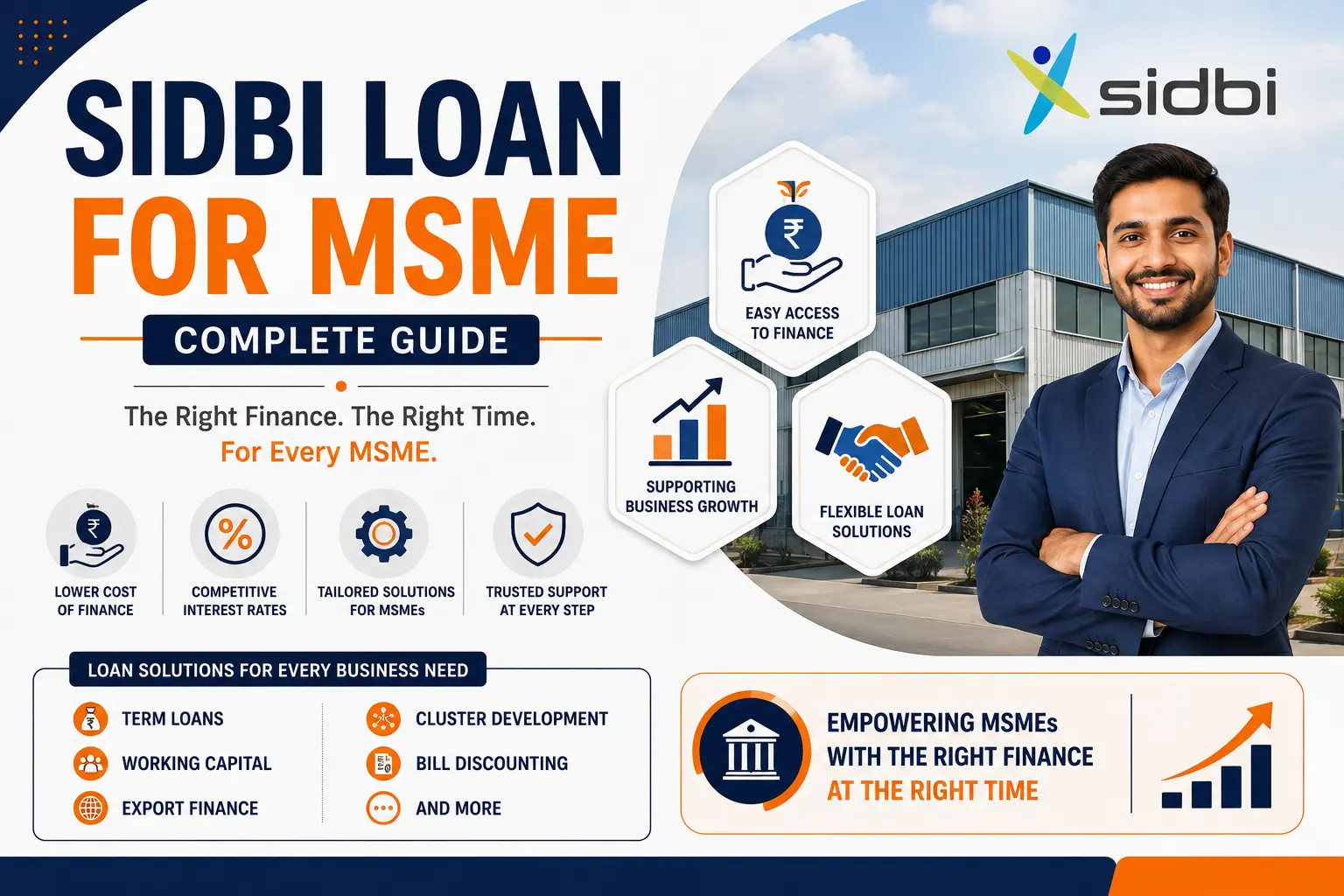
This guide explains SIDBI completely — what it is, its direct lending schemes (SMILE, SPEED, STAR, ASPIRE), exact 2026 interest rates, when SIDBI beats a regular bank loan, eligibility, and the step-by-step application process.
Quick Answer — SIDBI Loan for MSME 2026
SIDBI (Small Industries Development Bank of India) is the apex financial institution for India’s MSME sector — established in 1990 under the SIDBI Act. It provides both direct loans to MSMEs (through its own branches) and indirect finance (through refinancing partner banks and NBFCs). Key direct lending schemes in 2026 include SMILE (soft loan fund — Rs.10 lakh to Rs.25 crore, 3-year moratorium), SPEED (for smaller MSMEs up to Rs.1 crore — fast processing), and STAR (for technology adoption). Interest rates start at 8.15% per annum for eligible MSMEs. According to sidbi.in, SIDBI has cumulatively financed over 3.7 crore MSMEs since its inception — with a loan book exceeding Rs.4 lakh crore. Source: sidbi.in and msme.gov.in
What You Will Learn in This Guide:
✅ What SIDBI is — direct lender vs refinancing institution — the key difference
✅ SIDBI direct lending schemes — SMILE, SPEED, STAR, ASPIRE — each explained with real numbers
✅ SIDBI SMILE — soft loan with 3-year moratorium — when it is the best option
✅ SIDBI SPEED — for smaller MSMEs up to Rs.1 crore — fastest processing
✅ SIDBI interest rate 2026 — exact rates by scheme and credit profile
✅ SIDBI vs regular bank loan — when to choose which
✅ Eligibility — who SIDBI will and will not fund
✅ How to apply — SIDBI branch and online process
✅ Documents required — what SIDBI specifically asks beyond standard bank requirements
✅ Women and SC/ST benefits through SIDBI
✅ 5 real cases where SIDBI was better than a bank loan
✅ 10 FAQs
Table of Contents
What Is SIDBI — Direct Lender vs Refinancing Institution
SIDBI — Small Industries Development Bank of India — was established on April 2, 1990 under the SIDBI Act 1989. It is India’s apex financial institution for the MSME sector — operating under the Ministry of Finance.
Most people know SIDBI as the institution that “refinances banks for MSME lending.” This is accurate — but it is only half the picture. SIDBI has two distinct functions and understanding which one applies to you is critical.
Function 1 — Indirect Finance (Refinancing):
SIDBI provides refinancing to commercial banks, Regional Rural Banks, cooperative banks, NBFCs, and MFIs — enabling them to lend more to MSMEs. When a bank gives you a Mudra loan or a CGTMSE-backed MSME loan — SIDBI may be refinancing that bank behind the scenes. As a borrower, you never see SIDBI in this arrangement. You deal only with your bank.
Function 2 — Direct Finance (Direct Lending):
SIDBI also lends directly to MSMEs — through its own network of branches and online channels. When Priya applied at the SIDBI Coimbatore branch office — she was using SIDBI’s direct lending function. This is what most of this guide covers.
The critical distinction:
| Feature | SIDBI Indirect | SIDBI Direct |
|---|---|---|
| Who you deal with | Your bank — SIDBI invisible | SIDBI branch directly |
| Loan product | Bank’s MSME loan (bank’s label) | SIDBI scheme (SMILE, SPEED, STAR) |
| Who decides approval | Your bank’s credit committee | SIDBI’s credit committee |
| Interest rate | Bank’s MSME rate | SIDBI’s scheme rate |
| Best for | Most MSME borrowers | Specific situations — see below |
When to go directly to SIDBI:
Go directly to SIDBI when banks have rejected you for collateral reasons, when you need a long moratorium period (SMILE provides 3 years), when your business is in a manufacturing sector SIDBI specifically supports, or when you need the technical expertise of a lender who specifically understands MSME manufacturing operations.
SIDBI Direct Lending Schemes — SMILE, SPEED, STAR, ASPIRE
Four primary direct lending schemes in 2026:
| Scheme | Full Name | Target | Loan Amount | Interest Rate | Moratorium |
|---|---|---|---|---|---|
| SMILE | SIDBI Make in India Soft Loan Fund | Manufacturing MSMEs | Rs.10 lakh to Rs.25 crore | 2% below market + quasi-equity | 3 years |
| SPEED | SIDBI Loans for Purchase of Equipment for Enterprise Development | Small MSMEs | Up to Rs.1 crore | 9.25-10% | 3-6 months |
| STAR | SIDBI Transformative Use of Resources | Technology adoption | Up to Rs.2 crore | 8.15-9.5% | 6 months |
| ASPIRE | A Scheme for Promotion of Innovation, Rural Industries and Entrepreneurship | Rural MSMEs and startups | Up to Rs.1 crore | Market rate with CGTMSE | 3-6 months |
SIDBI SMILE Scheme — Soft Loan With 3-Year Moratorium
SMILE is SIDBI’s most powerful scheme for manufacturing MSMEs — and the one most business owners have never heard of.
What makes SMILE unique:
SMILE provides a combination of term loan and quasi-equity (soft loan). The soft loan component carries interest rate 2% below the standard SIDBI market rate — and most importantly, a 3-year moratorium on principal repayment. During the 3-year moratorium, you pay only interest — not principal. This dramatically reduces the pressure in the critical first 3 years when new manufacturing equipment is being brought up to full capacity.
SMILE scheme parameters:
| Parameter | Details |
|---|---|
| Loan amount | Rs.10 lakh (minimum) to Rs.25 crore |
| Quasi-equity component | Up to 20-25% of total project cost |
| Term loan component | Balance 75-80% |
| Interest on term loan | Market rate — SIDBI’s base rate + margin |
| Interest on soft loan | 2% below market rate |
| Moratorium | Up to 3 years on principal — interest paid throughout |
| Repayment tenure | Up to 10 years including moratorium |
| Collateral | Not required up to Rs.100 lakh — CGTMSE covers |
Real EMI calculation — SMILE scheme:
A manufacturing unit taking Rs.50 lakh under SMILE:
| Period | Principal Repayment | Interest (10%) | Total Monthly Payment |
|---|---|---|---|
| Months 1-36 (moratorium) | Rs.0 | Rs.41,667 | Rs.41,667 |
| Months 37-120 (repayment) | Varies | Declining | Rs.66,000-Rs.75,000 |
Without moratorium — same Rs.50 lakh at 10% over 10 years: Rs.66,134/month from Month 1.
The moratorium advantage:
Month 1 with SMILE: Rs.41,667 per month. Month 1 without moratorium: Rs.66,134 per month. That is Rs.24,467 less per month during the critical ramp-up period — when production is still building and cash flows are thin. Over 3 years of moratorium — cumulative saving vs no-moratorium: Rs.8,80,812 in cash flow advantage.
Who qualifies for SMILE:
Existing manufacturing MSMEs with at least 2-3 years of operation. New manufacturing units promoted by experienced entrepreneurs with sector track record. Units expanding capacity with new machinery. Units upgrading technology for Atmanirbhar Bharat-aligned production (electronics, defence, auto components, pharma).
SIDBI SPEED Scheme — For Smaller MSMEs Up to Rs.1 Crore
SPEED — SIDBI Loans for Purchase of Equipment for Enterprise Development — is SIDBI’s fastest-processing scheme for smaller manufacturing and service MSMEs.
SPEED scheme parameters:
| Parameter | Details |
|---|---|
| Loan amount | Up to Rs.1 crore |
| Purpose | Equipment and machinery purchase |
| Interest rate | 9.25% to 10% per annum |
| Moratorium | 3 to 6 months |
| Repayment | 2 to 5 years |
| Collateral | Not required — CGTMSE coverage available |
| Processing time | 7-15 working days for complete applications |
| Eligibility | New and existing MSMEs |
Why SPEED is Priya’s scheme:
Priya needed Rs.18 lakh for one CNC machine. SPEED is specifically designed for equipment purchase — not working capital, not construction, just machinery. The scheme parameters matched her need exactly: Rs.18 lakh under Rs.1 crore limit, 6-month moratorium to get the machine operational before EMI starts, 4-year repayment, CGTMSE coverage since SIPCOT lease land not accepted as collateral.
SPEED processing advantage:
SPEED has a faster credit decision process than standard SMILE because the risk is lower (smaller amounts, physical equipment as primary security) and the documentation is simpler. Complete files are processed in 7-15 working days — faster than most PSU banks for equivalent amounts.
Real EMI for Priya — Rs.18 lakh SPEED at 9.25%, 4 years, 6-month moratorium:
| Period | Monthly Payment |
|---|---|
| Months 1-6 (moratorium) | Rs.13,875 (interest only) |
| Months 7-54 (repayment) | Rs.23,480 (EMI) |
Priya’s income from the new CNC machine started generating from Month 3 onwards — well before full EMI began in Month 7.
SIDBI Interest Rate 2026 — By Scheme and Profile
SIDBI interest rates are not fixed — they vary by scheme, loan amount, credit profile, and whether CGTMSE coverage is applicable.
SIDBI direct lending rates — 2026:
| Scheme | Base Rate | Best Rate | For Whom |
|---|---|---|---|
| SMILE soft loan component | SIDBI PLR minus 2% | 8.15% | Excellent credit, manufacturing, Atmanirbhar sectors |
| SMILE term loan component | SIDBI PLR + margin | 9.5-11% | Standard manufacturing MSMEs |
| SPEED | SIDBI PLR + margin | 9.25-10% | Small MSMEs, equipment purchase |
| STAR | SIDBI PLR + margin | 8.15-9.5% | Technology adoption — green energy, digital |
| ASPIRE | Market rate with CGTMSE | 9.5-11% | Rural MSMEs, startups |
| Women entrepreneur schemes | SMILE/SPEED minus 0.5% | 8.75-9.5% | Women-promoted MSMEs |
Factors that determine your rate:
Credit rating (external rating — CRISIL, ICRA, CARE — or SIDBI’s internal assessment). Business vintage — more years = lower rate. Sector alignment with Atmanirbhar priority sectors — defence, electronics, pharma, auto components get preference. CGTMSE coverage — lower rate available when CGTMSE covers the loan. Promoter background — experienced promoters with sector track record get better pricing.
SIDBI rates vs bank rates — 2026 comparison:
| Loan Amount | Typical PSU Bank Rate | SIDBI SPEED Rate | SIDBI SMILE Rate |
|---|---|---|---|
| Rs.10-25 lakh | 10.5-12% | 9.25-10% | 8.15-9.5% |
| Rs.25 lakh-1 crore | 10-11.5% | 9.25-10% | 8.5-10% |
| Rs.1-5 crore | 9.5-11% | N/A (SPEED) | 8.5-10% |
| Rs.5-25 crore | 9-10.5% | N/A | 9-10.5% |
For most manufacturing MSMEs in the Rs.10 lakh to Rs.1 crore range — SIDBI SPEED rates are 0.5-2% lower than equivalent PSU bank rates. On Rs.50 lakh over 5 years — 1% lower rate saves Rs.1,35,000 in total interest.
SIDBI vs Regular Bank Loan — 10-Point Comparison
| Feature | Regular PSU Bank Loan | SIDBI Direct Loan |
|---|---|---|
| 1. Processing time | 7-25 working days | 7-21 working days (comparable) |
| 2. Officer expertise | General MSME understanding | Manufacturing and sector-specific expertise |
| 3. Moratorium | 3-6 months typically | Up to 36 months under SMILE |
| 4. Interest rate | 10-12% typically | 8.15-10% for eligible MSMEs |
| 5. Collateral | Property often demanded | CGTMSE covered — no property for up to Rs.10 crore |
| 6. Quasi-equity | Not available | Available under SMILE — unique benefit |
| 7. Technical appraisal | Limited | Strong — SIDBI has sector technical experts |
| 8. Sector understanding | Generic | Manufacturing, auto, pharma, defence, food processing specialists |
| 9. Relationship banking | Strong if existing account | New relationship — takes time to build |
| 10. Geographic reach | High — all districts | Limited — SIDBI branches in major cities |
When to choose SIDBI:
You are in manufacturing — specifically auto components, pharma, defence, electronics, food processing. You need a long moratorium — SMILE’s 3-year moratorium is unique. You have been rejected by banks for collateral reasons. Your loan is for specific equipment purchase (SPEED). You have an excellent credit profile and want to negotiate below-market rates.
When to choose a regular bank:
You are in services or trading — SIDBI focuses primarily on manufacturing. You are in a tier-3 town without a SIDBI branch nearby. You already have a strong banking relationship with a PSU bank. Your loan is below Rs.10 lakh — Mudra at your existing bank is simpler. You need a working capital CC/OD limit — SIDBI direct lending focuses on term loans.
Eligibility — Who SIDBI Will and Will Not Fund
Who SIDBI funds:
✅ Manufacturing MSMEs — all sectors, with priority to Atmanirbhar sectors
✅ Service MSMEs — IT, healthcare, logistics, professional services
✅ New businesses promoted by experienced entrepreneurs with sector background
✅ Existing businesses with minimum 2-3 years of operation (for SMILE)
✅ Udyam-registered enterprises
✅ Both sole proprietorships and companies — all entity types
✅ Enterprises aligned with Make in India, Atmanirbhar Bharat priority sectors
Specific eligibility for SPEED (most commonly used):
New enterprise: Promoter must have minimum 10th standard education. Existing enterprise: Minimum 1-2 years of operation. Both new and existing: Udyam Registration mandatory. Loan purpose: Equipment and machinery purchase — working capital not covered under SPEED.
Specific eligibility for SMILE:
Existing manufacturing MSMEs with 2-3 years of operation — or new units promoted by entrepreneurs with demonstrated sector experience. Minimum loan Rs.10 lakh. Project must be in manufacturing or closely allied services. Business must demonstrate ability to service interest during moratorium from existing income or initial production.
Who SIDBI does NOT typically fund:
❌ Trading businesses — SIDBI’s direct lending focus is manufacturing and manufacturing-aligned services
❌ Real estate — construction for own use
❌ Enterprises in CGTMSE negative list — alcohol, tobacco, meat processing
❌ Enterprises with active NPA on any institutional loan
❌ Enterprises whose promoters have been directors of defaulting companies
DSCR requirement:
SIDBI requires minimum DSCR of 1.30 — slightly higher than the standard 1.25 for PSU banks. This is because SIDBI’s credit appraisal is more technical and conservative. Ensure your project report DSCR is comfortably above 1.30 before applying.
Check your DSCR: Free DSCR Calculator
How to Apply — Branch and Online Process
Step 1 — Identify nearest SIDBI branch
SIDBI has branches in all major cities — Delhi, Mumbai, Kolkata, Chennai, Bengaluru, Hyderabad, Ahmedabad, Pune, Jaipur, Lucknow, Patna, Bhopal, Chandigarh, Coimbatore, Nagpur. Find nearest branch at sidbi.in — Branch Locator section.
Step 2 — Prepare comprehensive project report
SIDBI’s credit appraisal is more rigorous than a standard bank’s MSME desk. Your project report must include: detailed technical feasibility (machine specifications, production capacity, raw material sourcing), market analysis (current order book, customer pipeline, competitors), financial projections (5 years minimum), DSCR calculation (minimum 1.30), and promoter background and track record.
Generate your SIDBI-compatible project report at MudraReady — Rs.399, 10 minutes, first report FREE.
Step 3 — Initial meeting with SIDBI officer
Visit SIDBI branch with your project report and basic documents. The officer will assess whether your requirement aligns with SIDBI’s current scheme priorities. If it does — they will provide an application form and document checklist specific to your scheme (SPEED, SMILE, or STAR).
Step 4 — Technical appraisal (for larger loans)
For SMILE loans above Rs.50 lakh — SIDBI may conduct a technical appraisal of your proposed machinery and production plan. This is done by SIDBI’s own technical experts or empanelled consultants. The appraisal assesses whether your proposed machine is appropriate for the stated purpose and whether your production plan is achievable.
Step 5 — Credit committee decision
SIDBI’s credit committee reviews your application — project report, technical appraisal (if done), financial analysis, promoter assessment. Processing time 7-21 working days for complete applications. SPEED scheme typically faster — 7-15 working days.
Step 6 — Sanction and disbursement
Sanction letter issued. Loan agreement signed. For equipment purchase — disbursement may be direct to the machine supplier (SIDBI pays supplier directly) rather than to your account. This is common for SPEED and SMILE equipment loans.
Online application:
SIDBI has an online application portal at sidbi.in. Initial application can be submitted online. However, for most SIDBI direct loans above Rs.10 lakh — a branch visit is required for document verification and technical discussion. Online submission is a starting point, not the complete process.
Documents Required — SIDBI Specific Requirements
SIDBI requires standard MSME loan documents — plus some additional items that reflect its more technical appraisal approach.
Standard documents (same as any bank):
| Document | Source |
|---|---|
| Aadhaar Card | UIDAI |
| PAN Card | Income Tax Department |
| Udyam Registration Certificate | udyamregistration.gov.in |
| Bank Statement — 12 months | Your bank |
| ITR — last 3 years (existing businesses) | Income Tax portal |
| GST Returns — last 12 months | GST portal |
| Project Report / DPR | MudraReady — Rs.399 |
SIDBI-specific additional documents:
| Document | Why SIDBI Asks |
|---|---|
| Detailed machinery specification and quotation | Technical appraisal — is the machine appropriate? |
| Machine supplier’s track record and warranty documentation | Risk assessment on equipment |
| Current order book or customer letters of intent | Market demand validation |
| Promoter’s CV and sector experience documentation | Promoter assessment |
| SIPCOT/MIDC/Industrial estate allotment letter (if applicable) | Land tenure assessment for lease-hold premises |
| Environmental clearance (if applicable) | Regulatory compliance |
| Industry-specific certifications (ISO, BIS, FSSAI etc.) | Quality and compliance signal |
The order book requirement — why it matters:
SIDBI specifically asks for your current customer order book or letters of intent from customers. This is something most banks do not ask for but SIDBI considers critical. It validates that your expansion plans are backed by actual demand — not just projections. Before applying, prepare a summary of your 3-6 month order pipeline with customer names (can be anonymised if confidential) and order values.
Women and SC/ST — Benefits Through SIDBI
SIDBI has specific schemes and rate concessions for women entrepreneurs and SC/ST borrowers.
Women entrepreneurs:
SIDBI provides 0.5% interest rate concession for women-promoted MSMEs across all direct lending schemes. On Rs.50 lakh SPEED loan at 9.25% standard rate — women get 8.75%. Over 5 years — Rs.50 lakh × 0.5% × 5 = Rs.1,25,000 saving in total interest.
Additionally, SIDBI has dedicated women entrepreneurship programmes including Udyogini and MAHILA VIKAS schemes — providing capacity building alongside credit.
SC/ST entrepreneurs:
SIDBI channels NCGTC (National Credit Guarantee Trustee Company) backed loans for SC/ST entrepreneurs — providing enhanced collateral coverage similar to CGTMSE. Stand Up India loans processed through SIDBI for SC/ST entrepreneurs get priority consideration.
SIDBI + Mahila Udyam Nidhi:
Mahila Udyam Nidhi is a SIDBI scheme providing soft loans at concessional rates to women entrepreneurs for setting up or expanding enterprises in the tiny and small sector. Maximum Rs.10 lakh per project. Repayment up to 10 years. Contact nearest SIDBI branch for current year availability.
5 Real Cases — When SIDBI Beat the Bank
Case 1 — Priya Menon, Coimbatore (Already described in opening)
Two bank rejections due to SIPCOT lease land. SIDBI SPEED — Rs.18 lakh — 9.25% — 6-month moratorium — sanctioned in 21 working days. Machine installed. Business expanded.
Case 2 — 3-Year Moratorium Saved the Business
What happened: Rajan from Chennai — pharma packaging manufacturer — needed Rs.1.8 crore for new blister packaging line. The machine needed 18 months to reach full production capacity after installation. Banks offered 6-month moratorium maximum — meaning full EMI would start before the machine was even at 50% capacity.
SIDBI SMILE provided 36-month moratorium. Rajan paid only interest (Rs.1,50,000 per month) for the first 3 years — well within his existing revenue. By Month 37 when full EMI began — the new line was at 90% capacity and generating sufficient cash flow.
The lesson: SMILE’s 3-year moratorium is not just a convenience — for capital equipment with long ramp-up periods (pharma, engineering, food processing), it can be the difference between a successful expansion and a premature default.
Case 3 — Technical Expertise Mattered More Than Money
What happened: Deepa from Hyderabad — electronic components manufacturer — needed Rs.45 lakh for SMT (Surface Mount Technology) assembly line. When she approached standard banks, the MSME officers had no idea what SMT was or how to assess the machine’s value and utility.
SIDBI’s electronics sector specialist reviewed her application. Understood SMT production cycles, yield rates, and the specific Yamaha machine she was purchasing. Assessed the project correctly. Sanctioned Rs.45 lakh at 9.5% — with an informed understanding of her business that no bank officer had demonstrated.
The lesson: For technical manufacturing businesses in electronics, precision engineering, or specialty chemicals — SIDBI’s sector expertise produces faster, more informed credit decisions.
Case 4 — SIDBI When Bank Offered Worse Rate
What happened: Suresh from Pune — auto components manufacturer — applied for Rs.80 lakh term loan at his SBI home branch. SBI offered 11.25%. His CA suggested checking SIDBI. SIDBI SMILE — with his external CRISIL rating of BBB — offered 9.75%. Difference: 1.5% per annum. On Rs.80 lakh over 7 years: total interest saving = Rs.5,60,000. He chose SIDBI.
The lesson: For manufacturing MSMEs with external credit ratings (CRISIL, ICRA, CARE) — SIDBI rates are often significantly below what PSU banks offer. The rating process costs Rs.50,000-2,00,000 but the interest saving over a loan tenure can be 10x that.
Case 5 — ASPIRE for Rural MSME
What happened: Kavitha from rural Karnataka — organic spice processing unit — needed Rs.40 lakh for processing and packaging equipment. Located 60 km from a major city. Standard banks had no MSME officer in her nearest branch.
SIDBI ASPIRE scheme — specifically for rural MSMEs and agri-processing — provided Rs.40 lakh with CGTMSE coverage. The application was processed partly through SIDBI’s online portal and partly through a scheduled visit to her location by a SIDBI field officer.
The lesson: ASPIRE reaches rural MSMEs that standard bank MSME desks do not. For agro-processing, organic farming support, and rural manufacturing — ASPIRE is worth exploring even if the nearest SIDBI branch is not convenient.
Frequently Asked Questions
What is SIDBI and how is it different from a regular bank?
SIDBI — Small Industries Development Bank of India — is the apex financial institution for India’s MSME sector, established in 1990. Unlike regular banks that serve all customer types, SIDBI focuses exclusively on MSMEs. It provides both direct loans to MSMEs through its own branches and indirect finance by refinancing partner banks and NBFCs. The key difference from a regular bank is sector specialisation — SIDBI officers understand manufacturing processes, production cycles, and MSME industry dynamics in ways that general bank MSME officers typically do not. Source: sidbi.in
What is SIDBI SMILE scheme and who should apply?
SMILE (SIDBI Make in India Soft Loan Fund) is SIDBI’s most powerful scheme for manufacturing MSMEs. It provides a combination of term loan and quasi-equity soft loan — with the soft loan component carrying an interest rate 2% below the standard market rate and a moratorium of up to 3 years on principal repayment. Loan amount: Rs.10 lakh to Rs.25 crore. Best for: manufacturing MSMEs expanding capacity with long equipment ramp-up periods (pharma, auto components, electronics, food processing). Existing businesses with 2-3 years of operation or new units promoted by experienced entrepreneurs.
What is SIDBI SPEED scheme — how much loan can I get?
SPEED (SIDBI Loans for Purchase of Equipment for Enterprise Development) is SIDBI’s fastest-processing scheme for smaller MSMEs — specifically for equipment and machinery purchase. Maximum loan Rs.1 crore. Interest rate 9.25-10% per annum. Moratorium 3-6 months. Repayment 2-5 years. CGTMSE coverage available — no collateral required. Processing time 7-15 working days for complete applications. Both new and existing MSMEs eligible. Udyam Registration mandatory. Purpose must be equipment purchase — not working capital.
What is the interest rate for SIDBI loans in 2026?
SIDBI direct lending rates in 2026 range from 8.15% to 11% depending on scheme and credit profile. STAR scheme for technology adoption starts at 8.15%. SPEED for small MSMEs is 9.25-10%. SMILE term loan component is 9.5-11%. SMILE soft loan component is approximately 2% below the standard rate. Women entrepreneurs get 0.5% additional concession across all schemes. Enterprises with external credit ratings (CRISIL, ICRA, CARE) get the lowest rates within each scheme’s range.
Can new businesses get SIDBI loans?
Yes — but with conditions. For SPEED scheme — new businesses can apply with no minimum operation period, provided the promoter has relevant sector experience. For SMILE — new businesses are eligible if promoted by experienced entrepreneurs with demonstrated track record in the relevant manufacturing sector. SIDBI evaluates new businesses on promoter background and market demand evidence (order book, customer letters of intent) rather than historical financial statements.
Does SIDBI give loans without collateral?
Yes — SIDBI loans are covered under CGTMSE guarantee for loans up to Rs.10 crore, removing the collateral requirement. Priya’s Rs.18 lakh SPEED loan had no collateral — SIPCOT lease land was not accepted but CGTMSE guarantee replaced the collateral requirement. SIDBI arranges the CGTMSE guarantee on your behalf — you do not need to separately approach CGTMSE. Annual Guarantee Fee is built into the interest rate structure.
How is SIDBI different from Mudra loan?
Mudra loans (Rs.50,000 to Rs.20 lakh) are processed through commercial banks under the PMMY framework — the bank disburses and manages the loan. SIDBI direct loans are processed and disbursed by SIDBI itself — giving SIDBI direct control over credit assessment and repayment monitoring. Mudra is better for quick, smaller loans to any business type. SIDBI is better for manufacturing MSMEs needing larger amounts, longer moratorium, or technical credit appraisal. SIDBI is also a significant refinancing source behind many Mudra loans — even if you do not see SIDBI’s name on your Mudra loan.
What documents does SIDBI need beyond standard bank requirements?
Beyond standard documents (Aadhaar, PAN, Udyam, bank statement, ITR, GST returns, project report), SIDBI specifically requires: detailed machinery specification and quotation from the supplier, current order book or customer letters of intent showing demand, promoter CV with sector experience documentation, industrial estate allotment letter if premises are lease-hold (SIPCOT, MIDC, GIDC), and industry-specific certifications (ISO, BIS, FSSAI) if applicable. The order book requirement is critical — have at least 3-6 months of customer orders documented before applying.
Can women entrepreneurs get better rates from SIDBI?
Yes — SIDBI provides a 0.5% interest rate concession for women-promoted MSMEs across all direct lending schemes. On Rs.50 lakh over 5 years — this saves Rs.1,25,000 in total interest. Additionally, SIDBI has dedicated women entrepreneur schemes including Mahila Udyam Nidhi (soft loans up to Rs.10 lakh at concessional rates). SIDBI also channels priority allocation for women entrepreneurs under ASPIRE for rural MSMEs. Women-promoted micro enterprises get 85% CGTMSE coverage — the highest available.
Where can I apply for a SIDBI loan — is there an online option?
SIDBI has branches in all major cities. Find nearest branch at sidbi.in. Initial applications can be submitted online through the SIDBI portal. However, for most direct loans above Rs.10 lakh, a branch visit is required for document verification and technical discussion. ASPIRE scheme for rural MSMEs has a partially remote application process — SIDBI field officers visit the site. For SPEED loans below Rs.25 lakh — some SIDBI branches have faster desk-based processing without extensive site visits.
Conclusion — The Right Lender Changes Everything
Priya Menon was creditworthy from Day 1. Fourteen workers. Rs.1.4 crore turnover. Years of experience supplying automotive OEMs. Clear repayment capacity.
Two banks said no — not because of Priya but because of their processes. Their officers did not understand SIPCOT lease structures. Their collateral requirements did not accommodate her situation.
SIDBI said yes — because SIDBI was built for exactly this situation. A manufacturing MSME with strong fundamentals, equipment purchase purpose, and a specific land tenure situation that general banks could not process.
The machine is installed. The Tata Motors tier-1 order is being delivered. The Rs.23,480 monthly EMI is comfortable within her expanded revenue.
Knowing which lender to approach — and which scheme to request — is what makes the difference between three rejections and one approval.
Generate your SIDBI-compatible project report at MudraReady — Rs.399, 10 minutes, first report FREE.
Technical manufacturing format. DSCR minimum 1.30 verified. Order book section included. Accepted at SIDBI, SBI, PNB, Bank of Baroda and all major MSME lenders.
Sources: sidbi.in | msme.gov.in | cgtmse.in | udyamregistration.gov.in | SIDBI Annual Report 2024-25 | SMILE Scheme Guidelines 2024-25 | SPEED Scheme Guidelines 2024-25 | SIDBI Act 1989
Last Updated: Aug 2026
- Create new post for each
- Paste H1 title to Sources line
- FAQs — RankMath FAQ block for each
- Set focus keywords as listed
- Publish in scheduled order