Meena Verma spent three months preparing her Mudra Tarun loan application for her beauty salon in Jaipur. She had a CIBIL score of 724. Six years of business experience. A well-equipped salon with eight chairs and a loyal clientele. Her loan amount was Rs.5 lakh — reasonable for her business size.
Her project report showed a DSCR of 0.98. Bank of Baroda rejected her application. The rejection letter said three words that meant nothing to her at the time: “Insufficient debt coverage.”
She went to a CA friend who reviewed her project report. The CA found the error in four minutes.
Meena had calculated her DSCR using net profit only — she had not added back depreciation on her salon equipment (Rs.18,000 per year) or the interest on the term loan itself (Rs.42,500 per year) to the numerator. Both of these are non-cash or financing items that must be added back in the Indian bank DSCR formula.
Her corrected DSCR was 1.67. She regenerated her project report at MudraReady.in with the correct calculation. Resubmitted at the same Bank of Baroda branch. Approved in 15 working days.
The difference between rejection and approval was two line items in a formula she had never seen before.
This guide explains everything about DSCR — what it is, exactly how Indian banks calculate it (which is different from the global formula), worked examples for 8 different business types, what each bank and each scheme requires, why people get it wrong, and exactly how to improve yours if it is too low.
What You Will Learn in This Guide:
✅ What DSCR is — in plain language, no jargon
✅ The Indian bank DSCR formula — and why it differs from the global version
✅ Step-by-step DSCR calculation with real numbers
✅ DSCR worked examples for 8 business types — kirana, salon, dairy, poultry, garment, restaurant, medical store, tailoring
✅ Minimum DSCR required — bank-wise and scheme-wise comparison
✅ How depreciation affects DSCR — the most common calculation mistake
✅ How moratorium period changes DSCR calculation
✅ 5 real cases where wrong DSCR cost people their loan
✅ 6 strategies to improve your DSCR — with before and after numbers
✅ DSCR vs other financial ratios — what each measures
✅ 10 FAQs — every question applicants ask about DSCR
Table of Contents
What Is DSCR — The Number That Decides Your Loan
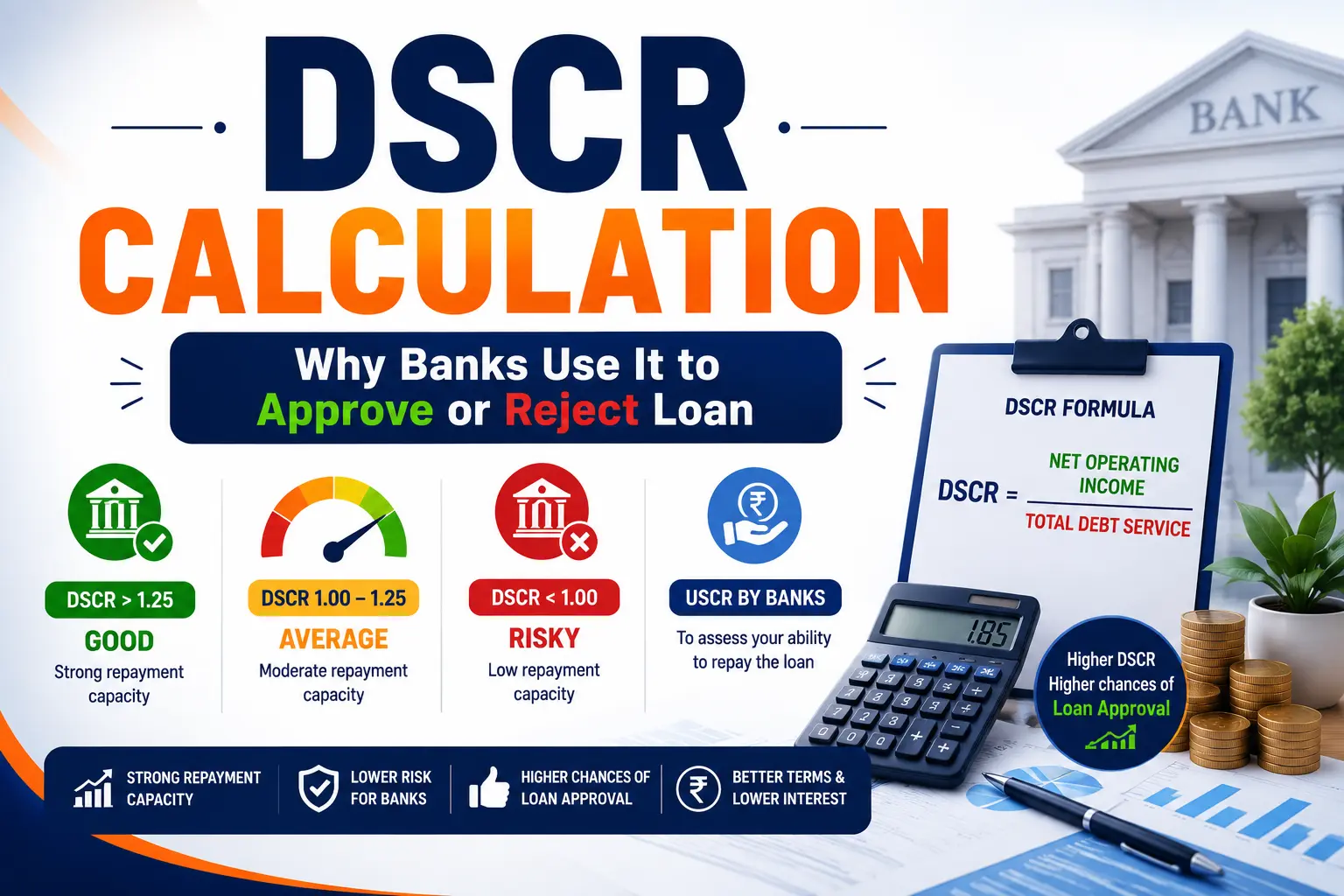
DSCR stands for Debt Service Coverage Ratio.
It is the single most important number in your project report. Not your CIBIL score. Not your business description. Not your market analysis. The DSCR is what bank credit officers look at first — because it answers the one question every lender has before approving any business loan:
“Does this business earn enough money to repay this loan — comfortably?”
The word “comfortably” is important. A DSCR of exactly 1.0 means your business earns just enough to repay the loan — no buffer. If anything goes wrong — a slow month, an unexpected expense, a delayed payment from a customer — you default. Banks do not find this comfortable.
A DSCR of 1.25 means your business earns 25% more than needed to repay the loan. A DSCR of 2.0 means your business earns double what you need to repay. Banks find these comfortable.
According to RBI’s MSME lending guidelines and IBA (Indian Banks’ Association) standard credit appraisal norms, a DSCR of 1.25 is the minimum required for service and trading businesses. Manufacturing businesses need 1.50 minimum because manufacturing involves higher operational risk.
DSCR interpretation guide:
| DSCR Value | What It Means | Bank’s Likely Response |
|---|---|---|
| Above 2.0 | Excellent — income is double the repayment need | Fast approval — low scrutiny |
| 1.75 to 2.0 | Very good — strong buffer | Approval likely — minimal queries |
| 1.50 to 1.75 | Good — acceptable buffer | Standard approval process |
| 1.25 to 1.50 | Acceptable — minimum comfortable buffer | Approved — may ask questions |
| 1.00 to 1.25 | Borderline — very thin buffer | May be declined or asked to reduce loan |
| Below 1.00 | Insufficient — cannot cover repayment | Almost certain rejection |
The DSCr Calculation Formula — Indian Bank Version vs Global Version
This is where most people — including many CAs and loan agents — make their first mistake. The Indian bank DSCR formula used in project reports and CMA data is different from the global finance textbook formula.
Global formula (not used by Indian banks for MSME loans):
DSCR = Net Operating Income ÷ Total Debt Service
Indian bank formula (used in IBA-standard project reports):
DSCR = (Net Profit After Tax + Depreciation + Interest on Term Loan) ÷ (Annual Term Loan Repayment + Interest on Term Loan)
The difference is in the numerator — what you add to net profit before dividing.
Why depreciation is added back:
Depreciation is a non-cash expense. Your business does not actually pay depreciation to anyone. It is an accounting entry that reduces your profit on paper — but the cash stays in your business. Since banks want to know how much cash your business generates to repay the loan, depreciation must be added back to net profit.
Why interest on term loan is added back:
Interest on the term loan you are applying for is already included in the denominator (annual debt service). If you also subtract it from net profit in the numerator — you are double-counting it. Adding it back to net profit prevents this double-counting.
Formula components explained:
| Component | What It Is | Where to Find It |
|---|---|---|
| Net Profit After Tax | Projected annual profit after all expenses and taxes | P&L projection in your project report |
| Depreciation | Annual reduction in asset value (WDV method — 15% for machinery) | Depreciation schedule in project report |
| Interest on Term Loan | Annual interest payment on the loan you are applying for | Repayment schedule in project report |
| Annual Term Loan Repayment | Total of 12 monthly EMI payments per year | Repayment schedule in project report |
Working capital interest — when to include:
If your loan includes a working capital component (CC/OD limit), the interest on working capital is included in the denominator. For pure term loans — only term loan repayment and interest appear in the denominator.
Step-by-Step DSCR Calculation With Real Numbers
Using Meena’s beauty salon as the base example — showing both her wrong calculation and the corrected version.
Meena’s salon — basic financial data:
| Item | Monthly (Rs.) | Annual (Rs.) |
|---|---|---|
| Revenue from services | 85,000 | 10,20,000 |
| Cost of materials (products used) | 12,000 | 1,44,000 |
| Staff salaries (2 assistants) | 18,000 | 2,16,000 |
| Rent | 12,000 | 1,44,000 |
| Electricity | 3,500 | 42,000 |
| Miscellaneous | 2,500 | 30,000 |
| Net Profit | 37,000 | 4,44,000 |
Loan details: Rs.5 lakh at 11% per annum over 5 years
Monthly EMI = Rs.10,871 | Annual repayment = Rs.1,30,452
Depreciation on salon equipment (Rs.3 lakh at 15% WDV) = Rs.45,000 per year
Annual interest on term loan = Rs.42,500 (Year 1)
MEENA’S WRONG CALCULATION:
| Component | Amount (Rs.) |
|---|---|
| Net Annual Profit (numerator) | 4,44,000 |
| Annual Repayment (denominator) | 1,30,452 |
| Interest on Term Loan (denominator) | 42,500 |
| DSCR (wrong) = 4,44,000 ÷ (1,30,452 + 42,500) | = 4,44,000 ÷ 1,72,952 = 2.57 |
Wait — this gives 2.57, not 0.98. So what was Meena’s actual error?
Meena’s error was that she had already deducted the loan EMI from her monthly expenses before calculating net profit — meaning she was paying the loan out of operating profit in her P&L, and then using that already-reduced profit in the DSCR numerator. This is the double-counting error.
The correct approach: Calculate net profit BEFORE any loan repayment deductions. Loan repayment appears only in the DSCR denominator — never as an operating expense in the P&L.
MEENA’S CORRECT CALCULATION:
| Component | Amount (Rs.) |
|---|---|
| Net Annual Profit (before any loan deduction) | 4,44,000 |
| Add: Depreciation | 45,000 |
| Add: Interest on Term Loan | 42,500 |
| Net Operating Income (numerator) | 5,31,500 |
| Annual Term Loan Repayment | 1,30,452 |
| Interest on Term Loan | 42,500 |
| Annual Debt Service (denominator) | 1,72,952 |
| DSCR = Rs.5,31,500 ÷ Rs.1,72,952 | = 3.07 ✅ |
A DSCR of 3.07 is strong. Bank approved in 12 working days.
Check your DSCR instantly — MudraReady’s free DSCR Calculator
DSCR calculation for 8 Different Business Types — Complete Worked Examples
These are the DSCR calculations Indian bank officers expect to see for each business type — with realistic numbers for Tier-2 and Tier-3 city operations.
Business Type 1 — Kirana Store (Rs.3 lakh Mudra Kishor)
| Item | Annual Amount (Rs.) |
|---|---|
| Net Annual Profit | 2,64,000 |
| Depreciation (shelving, counter at 10%) | 13,850 |
| Interest on Term Loan (Rs.3L at 11%) | 24,750 |
| Numerator | 3,02,600 |
| Annual Repayment | 78,432 |
| Interest | 24,750 |
| Denominator | 1,03,182 |
| DSCR | 2.93 ✅ |
Business Type 2 — Beauty Salon (Rs.5 lakh Mudra Tarun)
| Item | Annual Amount (Rs.) |
|---|---|
| Net Annual Profit | 4,44,000 |
| Depreciation (equipment at 15%) | 45,000 |
| Interest on Term Loan | 42,500 |
| Numerator | 5,31,500 |
| Annual Repayment | 1,30,452 |
| Interest | 42,500 |
| Denominator | 1,72,952 |
| DSCR | 3.07 ✅ |
Business Type 3 — Tailoring Shop (Rs.2 lakh Mudra Kishor)
| Item | Annual Amount (Rs.) |
|---|---|
| Net Annual Profit | 1,68,000 |
| Depreciation (2 machines at 15%) | 9,000 |
| Interest on Term Loan | 16,500 |
| Numerator | 1,93,500 |
| Annual Repayment | 52,288 |
| Interest | 16,500 |
| Denominator | 68,788 |
| DSCR | 2.81 ✅ |
Business Type 4 — Dhaba/Restaurant (Rs.8 lakh Mudra Tarun)
| Item | Annual Amount (Rs.) |
|---|---|
| Net Annual Profit | 3,60,000 |
| Depreciation (equipment, furniture at 10%) | 35,000 |
| Interest on Term Loan | 68,000 |
| Numerator | 4,63,000 |
| Annual Repayment | 2,08,723 |
| Interest | 68,000 |
| Denominator | 2,76,723 |
| DSCR | 1.67 ✅ |
Business Type 5 — Medical Store (Rs.5 lakh Mudra Kishor)
| Item | Annual Amount (Rs.) |
|---|---|
| Net Annual Profit | 3,00,000 |
| Depreciation (counter, computer at 40%/10%) | 28,000 |
| Interest on Term Loan | 42,500 |
| Numerator | 3,70,500 |
| Annual Repayment | 1,30,452 |
| Interest | 42,500 |
| Denominator | 1,72,952 |
| DSCR | 2.14 ✅ |
Business Type 6 — Dairy Farm (Rs.6 lakh NABARD DEDS)
| Item | Annual Amount (Rs.) |
|---|---|
| Net Annual Profit | 3,43,920 |
| Depreciation (shed, equipment at 10%/15%) | 22,500 |
| Interest on Term Loan (Rs.3.9L at 11%) | 31,200 |
| Numerator | 3,97,620 |
| Annual Repayment | 1,01,960 |
| Interest | 31,200 |
| Denominator | 1,33,160 |
| DSCR | 2.98 ✅ |
Business Type 7 — Poultry Farm — Broiler (Rs.8 lakh NABARD CISS)
| Item | Annual Amount (Rs.) |
|---|---|
| Net Annual Profit (6 cycles per year) | 4,80,000 |
| Depreciation (shed, equipment at 10%) | 52,000 |
| Interest on Term Loan (Rs.5.2L at 11%) | 44,200 |
| Numerator | 5,76,200 |
| Annual Repayment | 1,35,687 |
| Interest | 44,200 |
| Denominator | 1,79,887 |
| DSCR | 3.20 ✅ |
Business Type 8 — Garment Manufacturing Unit (Rs.10 lakh PMEGP)
| Item | Annual Amount (Rs.) |
|---|---|
| Net Annual Profit (Year 1) | 3,20,000 |
| Depreciation (machines at 15%) | 1,35,000 |
| Interest on Term Loan (Rs.7.5L at 11%) | 63,750 |
| Numerator | 5,18,750 |
| Annual Repayment | 1,96,090 |
| Interest | 63,750 |
| Denominator | 2,59,840 |
| DSCR | 2.00 ✅ |
Key observation across all 8 examples:
Notice that restaurant (1.67) and garment manufacturing (2.00) have lower DSCRs than retail businesses like kirana (2.93) or salon (3.07). This is because manufacturing and food service have higher operating costs relative to revenue — which is why banks require minimum 1.50 for manufacturing vs 1.25 for service and trading.
Minimum DSCR Required — Bank-Wise and Scheme-Wise
Bank-wise minimum DSCR requirements:
| Bank | Minimum DSCR — Service/Trading | Minimum DSCR — Manufacturing | Preferred DSCR | What They Focus On |
|---|---|---|---|---|
| SBI | 1.25 | 1.50 | 1.75+ | Balance sheet must balance exactly — DSCR errors trigger full file return |
| PNB | 1.25 | 1.50 | 1.50+ | Revenue projections must be locally consistent — unrealistic numbers flagged |
| Bank of Baroda | 1.25 | 1.50 | 1.50+ | Cash flow statement — Year 1 positive cash flow not expected; Year 2-3 is realistic |
| Canara Bank | 1.25 | 1.50 | 1.50+ | EDP certificate for PMEGP; DSCR calculation format must match IBA standard |
| Union Bank | 1.25 | 1.50 | 1.50+ | Consistent figures across P&L, balance sheet, and DSCR calculation |
| Small Finance Banks | 1.20 | 1.35 | 1.50+ | More flexible but charge higher interest |
| Cooperative Banks | 1.25 | 1.50 | 1.50+ | Local knowledge used to verify income projections |
Scheme-wise DSCR requirements:
| Scheme | Service/Trading Minimum | Manufacturing Minimum | Notes |
|---|---|---|---|
| Mudra Shishu (up to Rs.50K) | 1.25 | 1.25 | Simplified assessment — officers may estimate informally |
| Mudra Kishor (Rs.50K to Rs.5L) | 1.25 | 1.50 | Full DSCR calculation expected in project report |
| Mudra Tarun (Rs.5L to Rs.20L) | 1.25 | 1.50 | Formal IBA-format DSCR calculation mandatory |
| PMEGP | 1.25 | 1.50 | DLTFC committee also reviews — must be consistent with production capacity |
| CGTMSE | 1.25 | 1.50 | Higher scrutiny since no collateral — DSCR errors often caught here |
| Stand Up India | 1.25 | 1.50 | Bank retains discretion — SC/ST/women get some flexibility at borderline |
| PM Vishwakarma | 1.25 | 1.25 | Simplified for small amounts — but still formally calculated |
| NABARD DEDS/CISS | 1.25 | 1.50 | Biological risk considered — banks prefer 1.75+ for livestock |
How Depreciation Affects Your DSCR — Most People Get This Wrong
Depreciation is the single most commonly mishandled item in DSCR calculations. Most first-time project report preparers either forget to add it back entirely, or use the wrong depreciation rate.
Depreciation rates used by Indian banks (WDV method — Written Down Value):
| Asset Type | Annual Depreciation Rate |
|---|---|
| Plant and Machinery | 15% |
| Computers and Peripherals | 40% |
| Electrical Fittings | 10% |
| Furniture and Fixtures | 10% |
| Vehicles | 15% |
| Buildings | 5% |
How adding depreciation back changes DSCR — real example:
A mobile repair shop with Rs.3 lakh loan. Net annual profit Rs.1,80,000. Depreciation on tools and equipment (Rs.50,000 at 15%) = Rs.7,500.
| Calculation | Without Depreciation Add-Back | With Depreciation Add-Back |
|---|---|---|
| Numerator | Rs.1,80,000 + Rs.24,750 interest = Rs.2,04,750 | Rs.1,80,000 + Rs.7,500 + Rs.24,750 = Rs.2,12,250 |
| Denominator | Rs.78,432 + Rs.24,750 = Rs.1,03,182 | Same — Rs.1,03,182 |
| DSCR | 1.98 | 2.06 |
On a Rs.3 lakh loan the impact is modest — 0.08 DSCR improvement. But on a Rs.10 lakh loan with Rs.3 lakh of equipment depreciating at 15% — the depreciation add-back is Rs.45,000 per year — and the DSCR improvement can be 0.15 to 0.20 points. On a borderline DSCR of 1.15, that difference could mean the difference between approval and rejection.
Year-wise depreciation (WDV method — values reduce each year):
| Year | Opening Value (Rs.) | Depreciation at 15% (Rs.) | Closing Value (Rs.) |
|---|---|---|---|
| 1 | 3,00,000 | 45,000 | 2,55,000 |
| 2 | 2,55,000 | 38,250 | 2,16,750 |
| 3 | 2,16,750 | 32,513 | 1,84,237 |
| 4 | 1,84,237 | 27,636 | 1,56,601 |
| 5 | 1,56,601 | 23,490 | 1,33,111 |
In Year 1, depreciation add-back is Rs.45,000. By Year 5, it is only Rs.23,490. This means your Year 1 DSCR will be higher than Year 5 DSCR — all else being equal — purely because of declining depreciation. This is why financial projections show DSCR declining slightly over years even when income is growing — and why Year 3 DSCR is often the most scrutinised in a 5-year projection.
How Moratorium Period Affects DSCR Calculation
A moratorium is a period at the start of your loan during which you pay only interest — not principal. Many Mudra, PMEGP, and NABARD loans include a 6-month to 18-month moratorium for new businesses.
How moratorium changes your repayment schedule:
Rs.5 lakh Mudra Tarun loan at 11% over 5 years WITH 6-month moratorium:
| Period | Payment | Principal | Interest |
|---|---|---|---|
| Months 1-6 (Moratorium) | Interest only = Rs.4,583/month | Rs.0 | Rs.4,583 |
| Months 7-54 (EMI period) | Rs.11,122/month | Varies | Varies |
Without moratorium: Annual debt service in Year 1 = Rs.10,871 × 12 = Rs.1,30,452
With 6-month moratorium: Annual debt service in Year 1 = (Rs.4,583 × 6) + (Rs.11,122 × 6) = Rs.27,498 + Rs.66,732 = Rs.94,230
Impact on Year 1 DSCR:
| Scenario | Year 1 Debt Service | Net Operating Income | DSCR Year 1 |
|---|---|---|---|
| Without moratorium | Rs.1,30,452 | Rs.5,31,500 | 4.07 |
| With 6-month moratorium | Rs.94,230 | Rs.5,31,500 | 5.64 |
The moratorium makes Year 1 DSCR look very high — because you are paying less debt service that year. The critical year to check is Year 2 — when full EMI begins. Make sure your Year 2 income projection is realistic and your Year 2 DSCR is above the minimum.
Important: If your project report does not reflect the moratorium period in the repayment schedule — it is inconsistent with the actual loan terms. Bank officers catch this. Always include the moratorium in your repayment schedule if your loan category includes one.
DSCR Across 6 Government Schemes — What Each Requires
| Scheme | Minimum DSCR | Years of Projection Needed | Special DSCR Note |
|---|---|---|---|
| Mudra Kishor | 1.25 (service) / 1.50 (mfg) | 5 years | Year 2 DSCR most scrutinised after moratorium |
| Mudra Tarun | 1.25 (service) / 1.50 (mfg) | 5-7 years | Officers verify income vs local market rates |
| PMEGP | 1.25 (service) / 1.50 (mfg) | 5 years | DLTFC committee also checks production capacity vs revenue projections |
| CGTMSE | 1.25 (service) / 1.50 (mfg) | 5-7 years | Higher scrutiny — no collateral means DSCR is the primary approval lever |
| Stand Up India | 1.25 (service) / 1.50 (mfg) | 7 years | 18-month moratorium means Year 1 DSCR always high — Year 2-3 is critical |
| NABARD DEDS | 1.25 | 7-10 years | Livestock biological risk factored in — banks prefer 1.75+ for dairy |
| PM Vishwakarma | 1.25 | 3-5 years | Simplified assessment but formal calculation still expected by most banks |
| DAY-NULM | 1.25 | 3-5 years | SHG applications assessed collectively not individually |
For all scheme-specific project reports with auto-calculated DSCR: MudraReady.in
5 Real Cases Where Wrong DSCR Calculation Cost People Their Loan
Case 1 — Meena’s Beauty Salon — Double-Counted Loan EMI
Already described at the start of this guide. Meena deducted loan EMI as an expense in her P&L before calculating net profit — then used that already-reduced profit in the DSCR numerator without adding back interest. Her DSCR appeared lower than it was.
Lesson: Never include loan repayment as an operating expense in your P&L projection. Loan repayment belongs only in the DSCR denominator — never in the numerator calculation.
Case 2 — Rajesh’s Transport Business — Forgot Depreciation
Rajesh from Jaipur applied for Rs.8 lakh CGTMSE loan for a mini truck. His project report showed net profit of Rs.2,40,000 per year. He calculated DSCR as:
(Rs.2,40,000 + Rs.68,000 interest) ÷ (Rs.2,08,723 + Rs.68,000) = Rs.3,08,000 ÷ Rs.2,76,723 = 1.11
Below minimum 1.25. Rejected.
His CA pointed out he had forgotten depreciation on the truck — Rs.1,20,000 × 15% = Rs.18,000 per year. Wait — that is depreciation on a Rs.1.2 lakh truck component. The full truck cost Rs.8 lakh — depreciation at 15% = Rs.1,20,000 per year.
Corrected DSCR: (Rs.2,40,000 + Rs.1,20,000 + Rs.68,000) ÷ Rs.2,76,723 = Rs.4,28,000 ÷ Rs.2,76,723 = 1.55 ✅
Depreciation add-back alone moved his DSCR from 1.11 to 1.55 — from rejection to comfortable approval.
Lesson: For high-value assets like vehicles, machinery, and construction — depreciation add-back has massive impact on DSCR. Always calculate depreciation on your full asset base — not just small items.
Case 3 — Sunita’s Food Processing Unit — Ignored Working Capital Interest
Sunita from Pune applied for a PMEGP loan — Rs.10 lakh term loan plus Rs.2 lakh working capital CC limit. Her DSCR calculation included only the term loan repayment in the denominator. She forgot to include the working capital interest (Rs.2 lakh CC limit at 12% = Rs.24,000 per year).
Her stated DSCR: 1.68. Actual DSCR with working capital interest: 1.68 × (Rs.2,59,840 ÷ Rs.2,83,840) = 1.54.
The bank’s officer caught this during appraisal. Her file was returned for correction. She resubmitted with the corrected denominator. Still approved at 1.54 — but the error cost her 3 weeks.
Lesson: If your loan includes both a term loan AND a working capital component (CC/OD limit), include interest on working capital in the DSCR denominator. The formula becomes: (Net Profit + Depreciation + Term Loan Interest) ÷ (Term Loan Repayment + Term Loan Interest + Working Capital Interest).
Case 4 — Arvind’s Garment Unit — Inflation of Revenue Projections
Arvind from Surat applied for Rs.15 lakh CGTMSE loan for a garment manufacturing unit with 8 machines. His Year 1 revenue projection showed Rs.4.5 lakh per month — giving net annual profit of Rs.3.6 lakh and a DSCR of 1.52.
The bank credit officer calculated the maximum possible production: 8 machines × 4 garments per day × 25 working days × Rs.400 average selling price = Rs.3.2 lakh per month maximum at full capacity. Arvind’s projection was 41% above maximum possible output.
Officer recalculated DSCR with Rs.3.2 lakh monthly revenue at 70% capacity utilisation (industry standard for Year 1) = Rs.2.24 lakh monthly revenue. Revised net profit = Rs.1.44 lakh per year. Revised DSCR = 0.87.
Rejected.
Lesson: Your revenue projection must be mathematically derivable from your stated capacity — machines × output per day × working days × price per unit. Year 1 should show 60-70% capacity utilisation. DSCR built on inflated revenue is not a DSCR — it is a fiction that bank officers see through immediately.
Case 5 — Kavita’s Dairy Farm — Wrong Depreciation Rate for Livestock
Kavita from Maharashtra set up a dairy unit with 8 buffaloes. Her project report included the buffaloes in fixed assets at Rs.3.2 lakh and applied 15% depreciation (machinery rate) — giving Rs.48,000 depreciation add-back per year.
Bank’s agricultural officer flagged: livestock is not depreciated at 15% machinery rate. Livestock is depreciated at a special rate — typically 10% per year or per RBI guidelines for agricultural assets. The bank recalculated using 10%.
Revised depreciation = Rs.32,000 per year (not Rs.48,000).
Her DSCR dropped from 1.62 to 1.55 — still above minimum 1.25, so she was approved. But if her original DSCR had been 1.30, the correction would have brought it below 1.25 and she would have been rejected.
Lesson: Use the correct depreciation rate for each asset type. Livestock — 10%. Buildings — 5%. Machinery — 15%. Computers — 40%. Vehicles — 15%. Using 15% for everything inflates your depreciation add-back and therefore your DSCR artificially. MudraReady applies correct depreciation rates automatically.
How to Improve Your DSCR — 6 Strategies With Numbers
If your DSCR calculation comes out below 1.25, do not despair and do not fabricate numbers. Here are 6 legitimate strategies to improve DSCR — each shown with before-and-after numbers.
Strategy 1 — Reduce the Loan Amount
This is the most straightforward fix. A smaller loan means smaller annual debt service — which improves DSCR without changing your income.
| Scenario | Loan Amount | Annual Debt Service | Net Operating Income | DSCR |
|---|---|---|---|---|
| Original request | Rs.8 lakh | Rs.2,08,723 | Rs.2,20,000 | 1.05 ❌ |
| Reduced request | Rs.6 lakh | Rs.1,56,542 | Rs.2,20,000 | 1.41 ✅ |
By reducing loan from Rs.8 lakh to Rs.6 lakh — DSCR jumps from 1.05 to 1.41. The remaining Rs.2 lakh can come from own contribution or from a smaller business expansion in Phase 2.
Strategy 2 — Extend the Repayment Tenure
Longer tenure = lower annual repayment = improved DSCR.
| Scenario | Loan | Tenure | Annual Repayment | DSCR |
|---|---|---|---|---|
| 5-year tenure | Rs.5 lakh at 11% | 5 years | Rs.1,30,452 | 1.12 ❌ |
| 7-year tenure | Rs.5 lakh at 11% | 7 years | Rs.1,00,584 | 1.45 ✅ |
Extending from 5 to 7 years reduces annual repayment by Rs.29,868 — moving DSCR from rejection to approval.
Strategy 3 — Increase Promoter Contribution
Putting more of your own money into the project reduces the loan amount — directly improving DSCR.
| Scenario | Project Cost | Own Contribution | Loan Amount | DSCR |
|---|---|---|---|---|
| 10% own contribution | Rs.10 lakh | Rs.1 lakh | Rs.9 lakh | 1.18 ❌ |
| 25% own contribution | Rs.10 lakh | Rs.2.5 lakh | Rs.7.5 lakh | 1.41 ✅ |
Strategy 4 — Add a Second Revenue Stream
If your business has a potential additional revenue source — add it to your projections with supporting rationale.
A kirana store owner who also plans to do home deliveries — adding delivery revenue of Rs.5,000 per month (conservative and very achievable) adds Rs.60,000 to annual income. On a borderline DSCR of 1.20, this could push it to 1.35. The key — the additional revenue must be plausible and explainable in your market analysis section.
Strategy 5 — Apply for a Moratorium Period
As shown in Section 7, a 6-month moratorium significantly reduces Year 1 debt service — improving Year 1 DSCR substantially. If your scheme offers a moratorium — apply for it and reflect it correctly in your repayment schedule and DSCR calculation.
Strategy 6 — Include All Depreciable Assets
Check your asset list. Did you include all eligible assets at the correct depreciation rate? Sometimes applicants understate their fixed assets (to show a smaller project cost for a smaller loan) — which also reduces their depreciation add-back and therefore their DSCR.
If you have genuine assets — equipment, vehicles, furniture — make sure they are all included in the project cost and the depreciation schedule. Each correctly included asset improves your DSCR.
DSCR vs Other Financial Ratios — What Each Measures
Banks evaluate multiple financial ratios from your project report — DSCR is the most important, but not the only one.
| Ratio | Formula | Minimum Required | What It Measures | How It Relates to DSCR |
|---|---|---|---|---|
| DSCR | Net Operating Income ÷ Annual Debt Service | 1.25 (service) / 1.50 (mfg) | Can the business repay this specific loan from operations? | Primary ratio — most important |
| Current Ratio | Current Assets ÷ Current Liabilities | 1.33 (Tandon Method) | Does the business have enough liquid assets to pay short-term dues? | Complements DSCR — liquidity check |
| Debt-Equity Ratio | Total Debt ÷ Net Worth (Equity) | Below 3:1 preferred | How leveraged is the business — how much debt vs owner’s own money? | Context for DSCR — high DE ratio makes borderline DSCR more concerning |
| Gross Profit Margin | Gross Profit ÷ Revenue × 100 | Varies by industry | Is the core business activity profitable before overheads? | Feeds into DSCR — low GPM means low net profit means low DSCR |
| Break-Even Point | Fixed Costs ÷ (Price per Unit − Variable Cost per Unit) | Should be achievable in Year 1-2 | At what sales level does the business start making money? | Indicates minimum revenue needed — affects DSCR at various capacity utilisations |
| MPBF (Max Permissible Bank Finance) | 75% of (Current Assets − Current Liabilities) | NA — it is a limit not a minimum | Maximum working capital the bank will fund | Determines working capital component of loan — affects denominator in DSCR |
Calculate your Break-Even Point free at MudraReady
Calculate your MPBF free at MudraReady
Frequently Asked Questions
What is DSCR and why is it important for a bank loan?
DSCR stands for Debt Service Coverage Ratio. It is the single most important number in your project report — the ratio of your business’s annual income to your annual loan repayment. A DSCR of 1.25 means your income is 25% more than needed to repay the loan. Indian banks require a minimum DSCR of 1.25 for service and trading businesses and 1.50 for manufacturing businesses before approving any MSME loan. A DSCR below 1.0 means near-certain rejection.
What is the DSCR formula used by Indian banks?
Indian banks use: DSCR = (Net Profit After Tax + Depreciation + Interest on Term Loan) ÷ (Annual Term Loan Repayment + Interest on Term Loan). This differs from the global formula because it adds back depreciation (a non-cash expense) and interest (already in denominator) to the numerator. These add-backs are the most commonly missed components in first-time project reports.
What is the minimum DSCR for a Mudra loan?
For Mudra Kishor and Tarun loans covering service or trading businesses — minimum DSCR is 1.25. For manufacturing businesses — minimum DSCR is 1.50. Most banks prefer 1.50 or above for faster processing. A DSCR of 1.75 or above significantly speeds up approval at busy branches and reduces the likelihood of follow-up queries. Check your DSCR free at MudraReady.
Why is depreciation added back in the DSCR calculation?
Depreciation is a non-cash accounting entry — it reduces your profit on paper but no actual cash leaves your business. Since DSCR measures your ability to repay using cash generated by the business, depreciation must be added back to net profit. Without this add-back, your DSCR appears lower than your actual cash repayment capacity. Forgetting this add-back is the single most common DSCR calculation error in first-time project reports.
What happens if my DSCR is below 1.25?
Several options — in order of simplicity: reduce your loan amount (smaller loan = smaller repayment = higher DSCR), extend your repayment tenure from 5 to 7 years (lower annual repayment), increase your promoter contribution (smaller loan needed), add a realistic secondary revenue stream to your projections, or apply for a moratorium period to reduce Year 1 debt service. Never inflate revenue projections to artificially improve DSCR — bank officers verify projections against local market rates and production capacity.
Is DSCR the same for all loan schemes?
The formula is the same but the minimum requirement varies slightly by scheme and business type. Most schemes require 1.25 for service and 1.50 for manufacturing. NABARD dairy and poultry loans — banks prefer 1.75 or above given biological risk. CGTMSE loans face more scrutiny on DSCR since there is no collateral — banks compensate for higher risk by wanting higher DSCR. PM Vishwakarma and Mudra Shishu are assessed more informally but the formal minimum still applies.
Can DSCR be different in different years of my projection?
Yes — and it typically is. Year 1 DSCR is often the lowest because revenue is ramping up from zero. Years 2-5 DSCR should improve as the business establishes its customer base. Banks typically look at the average DSCR across all 5 projected years — but Year 2 and Year 3 are most scrutinised because Year 1 is too early and Year 5 projections are considered uncertain. Ensure your DSCR is above minimum in every year, not just the average.
How does a moratorium period affect DSCR?
During the moratorium period you pay only interest — not principal. This reduces your annual debt service in Year 1 significantly, making Year 1 DSCR appear very high. The critical year to check is Year 2 — when full EMI begins. Ensure your Year 2 DSCR is above the minimum required. Also, your project report’s repayment schedule must correctly show the moratorium period — inconsistency between the loan terms and the repayment schedule in your report triggers officer scrutiny.
What is the difference between DSCR and current ratio?
DSCR measures your ability to repay a specific loan from operating income — it is a long-term solvency ratio. Current ratio measures your ability to pay short-term debts using liquid assets (current assets ÷ current liabilities) — it is a short-term liquidity ratio. Both are checked by banks. Minimum current ratio required by most banks is 1.33 (per RBI’s Tandon Committee norms for working capital assessment). A business can have a strong DSCR and a weak current ratio — both need attention in your project report.
How do I calculate DSCR without making mistakes?
Use MudraReady’s free DSCR Calculator — it applies the correct Indian bank formula, includes depreciation at the right rate for each asset type, handles moratorium periods correctly, and shows year-wise DSCR across your projection period. Alternatively, follow this checklist manually: 1) Calculate net profit BEFORE any loan repayment deductions. 2) Add back depreciation at correct WDV rates. 3) Add back interest on term loan. 4) Divide by (annual EMI + annual interest + working capital interest if any). 5) Check result is 1.25+ for service or 1.50+ for manufacturing.
Conclusion — DSCR Is Not Complicated. Getting It Right Is.
Meena Verma’s DSCR was not actually 0.98. It was 3.07. The difference was two line items — depreciation and interest — that she had either omitted or miscounted.
Three months of preparation. One four-minute correction by a CA friend. Approval in 12 working days.
DSCR itself is a straightforward formula. The errors happen in what you include and exclude — loan repayment in the P&L, missing depreciation, wrong asset rates, forgotten working capital interest, ignored moratorium period.
Every one of these errors is avoidable. Every one of these errors has cost real applicants weeks or months of delay.
Check your DSCR free at MudraReady.in — before submitting your project report.
And if you are ready to generate a complete project report with DSCR auto-calculated, balance sheet auto-balanced, and repayment schedule correctly reflecting your moratorium — start here — Rs.399, 10 minutes, first report FREE.
Sources: rbi.org.in — MSME Lending Guidelines | sidbi.in — MSME Pulse Report 2024-25 | msme.gov.in | IBA Standard Credit Appraisal Format 2025-26 | RBI Tandon Committee Norms for Working Capital Assessment
Last Updated: July 2026